
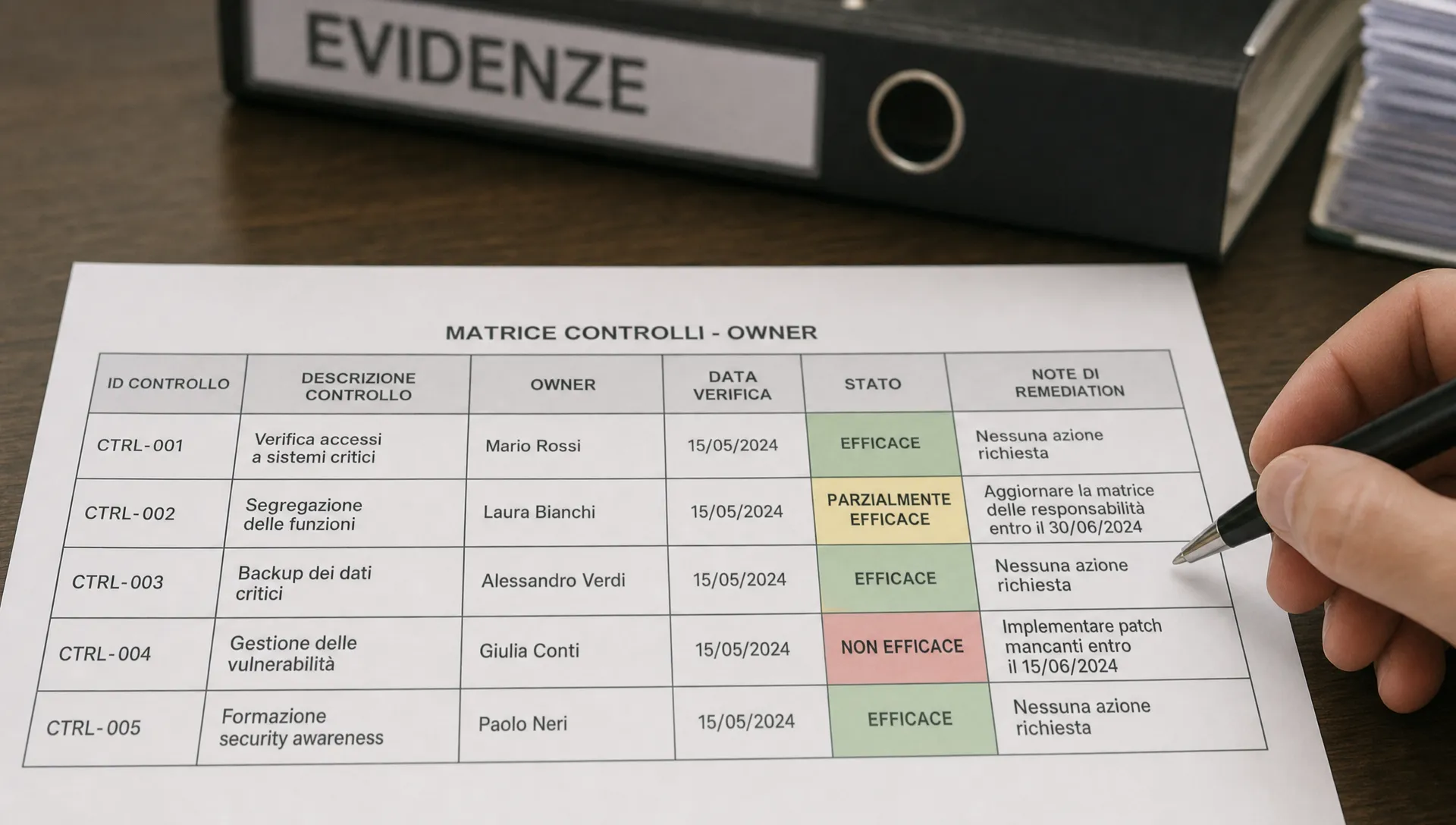
When compliance lives in generic spreadsheets, scattered shared folders and ad-hoc messages, the problem is more than messy documents. The real weakness is the inability to demonstrate who was responsible for a control, what evidence proves it, when that evidence was produced, and how exceptions were handled.
A controls–owner matrix converts requirements, policies and recurring activities into verifiable responsibilities. It does not replace legal or regulatory interpretation, but it gives compliance managers, DPOs, CISOs, IT managers and internal auditors an operational, auditable structure to show during internal reviews, customer audits and assessments under frameworks such as GDPR, NIS2, DORA and ISO standards.
The guidance below is practical: it shows how to structure controls, owners, evidence, frequencies, audit trails and remediation. For interpretation of which obligations apply to your organization, consult legal or subject-matter experts.
Why a controls–owner matrix moves you from stated to proven compliance
Many organizations can say “we have a policy,” but struggle to prove the policy was applied consistently. During an audit, a statement isn’t enough: auditors expect dated, consistent evidence attributable to a named owner and linked to the requirement or risk being addressed.
This approach aligns with accountability principles in GDPR, the risk management emphasis of NIS2, and the ICT risk and operational resilience focus in DORA. The practical outcome is the same across frameworks: controls must be demonstrable.
A usable control should have at least four elements: an operational owner, the expected evidence, a verification frequency, and an escalation or remediation path if the control fails. Without these, compliance depends on people’s memory and becomes fragile with staff changes, supplier swaps or shifting priorities.
What a controls–owner matrix is (and what it is not)
A controls–owner matrix is an operational table linking requirements, risks, controls, owners, evidence and execution status. It’s not just a RACI and not merely a ledger of controls — its purpose is to show the path from “this must be done” to “this was done, by this person or team, with this evidence.”
The matrix is most effective when it distinguishes three often-confused roles: the requirement owner (who oversees the obligation or standard), the control owner (who executes the control) and the evidence owner (who produces or validates the proof). In small organizations these roles may be combined, but they should still be explicit.
If you need a broader responsibility map (who is consulted, informed, accountable), you can complement the matrix with a responsibility assignment matrix. The controls–owner matrix, however, is audit-focused because it starts with the control and ends with the evidence.
Minimum columns to include
A practical matrix avoids both over-complexity and oversimplification. Too many fields slow owners and create maintenance overhead; too few leave you unable to respond to audit queries. Start with columns that answer an auditor’s basic questions: which requirement, who executes it, what proof exists, when it was produced, and what happens if it’s not compliant.
- Area/framework: map the control to GDPR, NIS2, DORA, ISO or internal model (e.g., Privacy, ICT security, Supplier risk)
- Operational requirement: turn the obligation into a verifiable need (e.g., periodic review of privileged access)
- Control description: the concrete activity to perform (e.g., quarterly admin account review)
- Control owner: the person or role responsible for executing the control (e.g., IT manager, CISO)
- Expected evidence: the artifact to store (e.g., IAM export, approved ticket, review minutes)
- Frequency: when the control is performed (monthly, quarterly, on-event)
- Status & remediation: result, deviations and corrective actions (compliant, partial, non-compliant, remediation in progress)
This setup supports both planning (preventive) and audit preparation (consumptive). A control without evidence is not demonstrable; evidence without an owner is not governable.
Build the matrix without creating needless bureaucracy
-
Limit the initial scope. Start with high-priority areas such as privileged access, incident handling, critical suppliers, privacy registers or business continuity. Attempting the entire organization at once often produces a stale, oversized matrix.
-
Translate requirements into observable controls. “Manage supplier risk” is too broad; “annually collect security evidence from critical suppliers” is an operational control that someone can perform and that leaves a trace.
-
Clarify what the owner must do. Don’t assign a control by title only—specify the evidence to produce, the location to store it, and who approves the result. For high-impact controls, separate the executor from the approver.
-
Treat the matrix as a living artifact. Organizational changes, new systems, decommissioned services and incident findings will all require updates. Set a regular cadence to review and refresh the matrix rather than filling it only before audits.
Practical example
The example below illustrates the mapping between control, owner and evidence. It’s intentionally generic — use it to model the linking logic, not as a checklist for full regulatory coverage.
-
Area: Access Management
- Control: Quarterly review of users with administrative privileges
- Control owner: IT Manager
- Expected evidence: Export of IAM users, approval tickets, revocation records
- Frequency: Quarterly
- Possible statuses: Compliant, exceptions open
-
Area: Privacy
- Control: Update data processing register when a new process is introduced
- Control owner: DPO or data owner
- Expected evidence: Updated register entry, approval date, business owner
- Frequency: On event
- Possible statuses: Updated, requires completion
-
Area: Incident Management
- Control: Classification and logging of relevant incidents
- Control owner: CISO or Incident Manager
- Expected evidence: Incident log, timeline, decisions, closure actions
- Frequency: On event
- Possible statuses: Closed, under analysis, remediation in progress
-
Area: Supplier Risk
- Control: Collection of evidence from critical suppliers
- Control owner: Procurement or Vendor Manager
- Expected evidence: Questionnaire responses, attestations, assessment reports
- Frequency: Annually or at contract renewal
- Possible statuses: Accepted, mitigation required
-
Area: Business Continuity
- Control: Test of continuity or recovery plan
- Control owner: Business Continuity Owner
- Expected evidence: Test report, outcomes, remediation plan
- Frequency: Annually
- Possible statuses: Passed, partial, failed
Each piece of evidence should include a version, date, owner and link back to the control. Without that, the matrix is only an index and not proof.
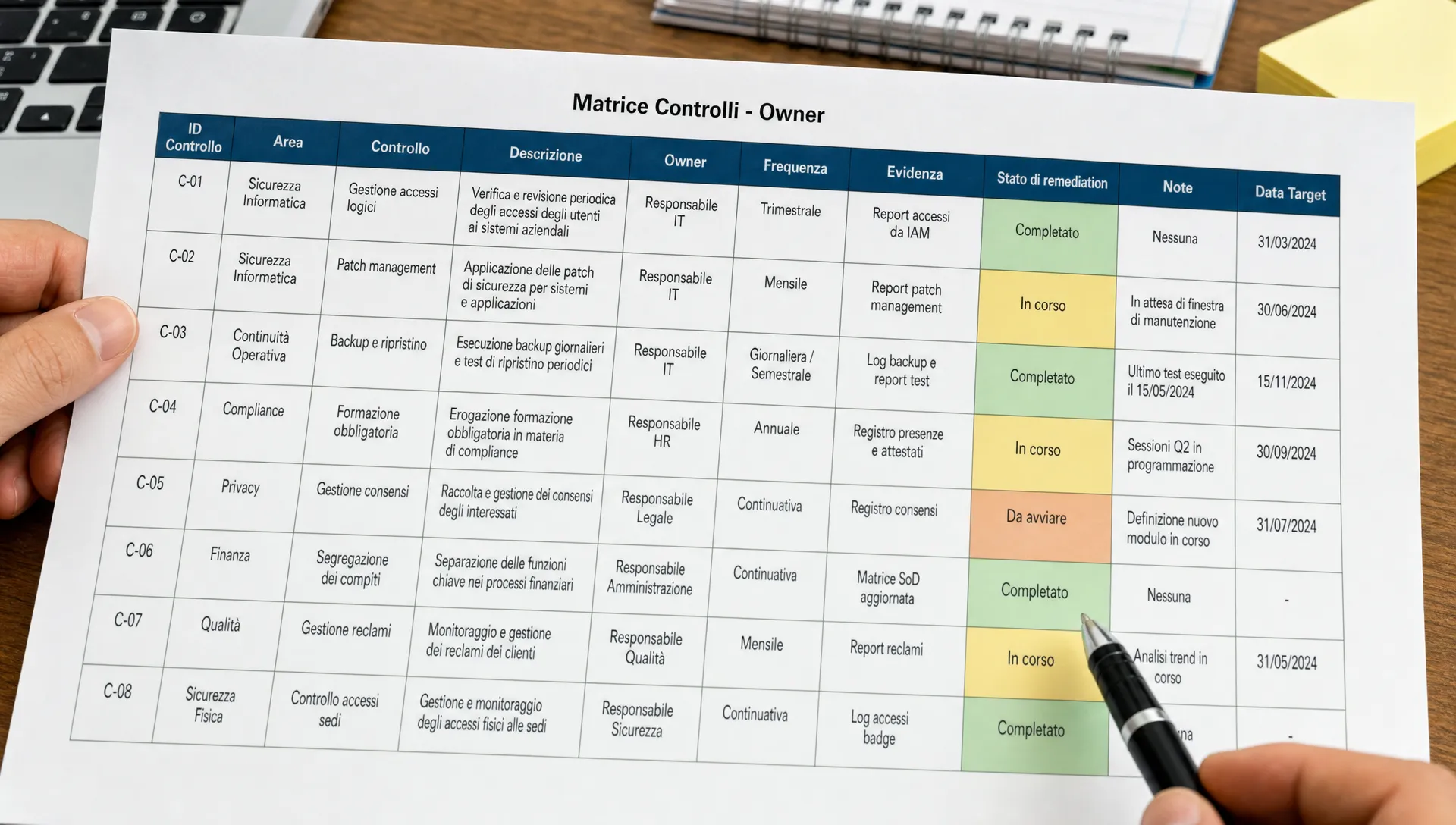
Making evidence audit-ready
Strong evidence allows an external reviewer to understand what was done without relying on oral reconstruction. A file named “final access review” is insufficient unless it shows scope, date, source, verification criteria, approval and any exceptions.
Link each evidence item to the corresponding matrix row and include coverage period, owner, source system, version and control outcome. If the control generated anomalies, the evidence should point to the finding and the remediation record.
For more on evidence quality, see our guide to audit evidence at /en/blog/audit-evidence. If your issue is proving who changed what and when, review best practices on audit trails at /en/blog/audit-trail-best-practices.
The goal is not just to store documents but to maintain the link between document, control and decision. That link reduces audit disputes, avoids duplication and clarifies real coverage gaps.
Link findings, remediation and ownership
A controls–owner matrix that only records green controls is incomplete. Effective audits reveal exceptions, delays and partial controls. The value is not hiding deviations but showing they have an owner, a due date and a verification criterion.
When a control fails, the matrix row should link to a finding record describing the deviation, the related risk and the corrective action. The remediation must have a clearly identified owner (not just “IT” or “Compliance”) and a defined closure test to avoid ambiguity and delays.
You can integrate the matrix with a non-conformance management process — see /en/blog/effective-nonconformity-management-with-owners-and-deadlines — so the matrix feeds a verifiable improvement cycle rather than being an audit snapshot.
Common mistakes to avoid
-
Assigning all controls to the compliance function. Compliance can coordinate and verify but should not be the operational owner of IT, HR or procurement activities. If everything belongs to compliance, the matrix loses managerial value.
-
Using generic evidence. Policies and slide decks show the existence of documentation, not execution. Audit-proof evidence includes approvals, logs, tickets, exports, meeting minutes, sample checks and corrective actions.
-
Not versioning changes. If owners, frequencies or scopes change, record who made the change, when and why. In an audit, knowing a row was updated is less helpful than knowing the who/when/why.
Treat these failures as process flaws, not mere administration. A well-maintained matrix reveals cross-functional dependencies and allows proactive closure of gaps before they surface in an audit.
How to use the matrix before, during and after an audit
-
Before an audit: use the matrix for readiness assessments. Filter controls lacking evidence, missing owners, expired frequencies or open remediations to prepare a realistic audit pack rather than searching for documents at the last minute.
-
During an audit: the matrix becomes a navigation map. Auditors can start from a requirement, find the control, confirm the owner and open the evidence. When information is coherent, the team responds with artifacts instead of repeated explanations.
-
After an audit: update the matrix to capture findings. Each observation should update an existing row or create a new one with remediation, deadline and a closure criterion. This turns audits into inputs for the next control cycle rather than isolated events.
FAQ
Q: Is a controls–owner matrix legally required?
A: Not in a specific format. It is a practical tool to demonstrate responsibilities, controls and evidence. Legal obligations depend on the applicable framework and should be reviewed with legal or specialist advice.
Q: How does the matrix differ from a non-conformity register?
A: The matrix plans and monitors controls, owners and evidence. A non-conformity register manages findings, corrective actions and closures. The two should be connected.
Q: Who keeps the matrix up to date?
A: Typically a compliance, risk, security or internal audit function coordinates it, but operational owners must update control status and supply evidence. Responsibility should not rest on a single team.
Q: Does every control require documentary evidence?
A: Yes, to be audit-proof. Evidence can be reports, tickets, logs, minutes, exports or attestations, but it must be attributable to the control, period and owner.
Q: How to use the matrix across multiple frameworks?
A: A single control can map to multiple frameworks if the evidence covers the different requirements. The key is to map each control to the relevant obligations without duplicating work and to keep the coverage of each evidence item clear.
Build an audit-ready matrix
A well-designed controls–owner matrix reduces firefighting and clarifies who does what, what proof is required, which controls are uncovered and which remediations are outstanding. For teams subject to frequent assessments, this is often the step that converts compliance from a documentation exercise into a repeatable operational process.
If NIS2 readiness is a priority and you need to organize controls, evidence, owners and remediations in an auditable way, consider requesting an AuditReady demo for NIS2 evidence preparation at /en/auditready/lp/nis2.
audit-ready evidence pack demo / not legal advice