
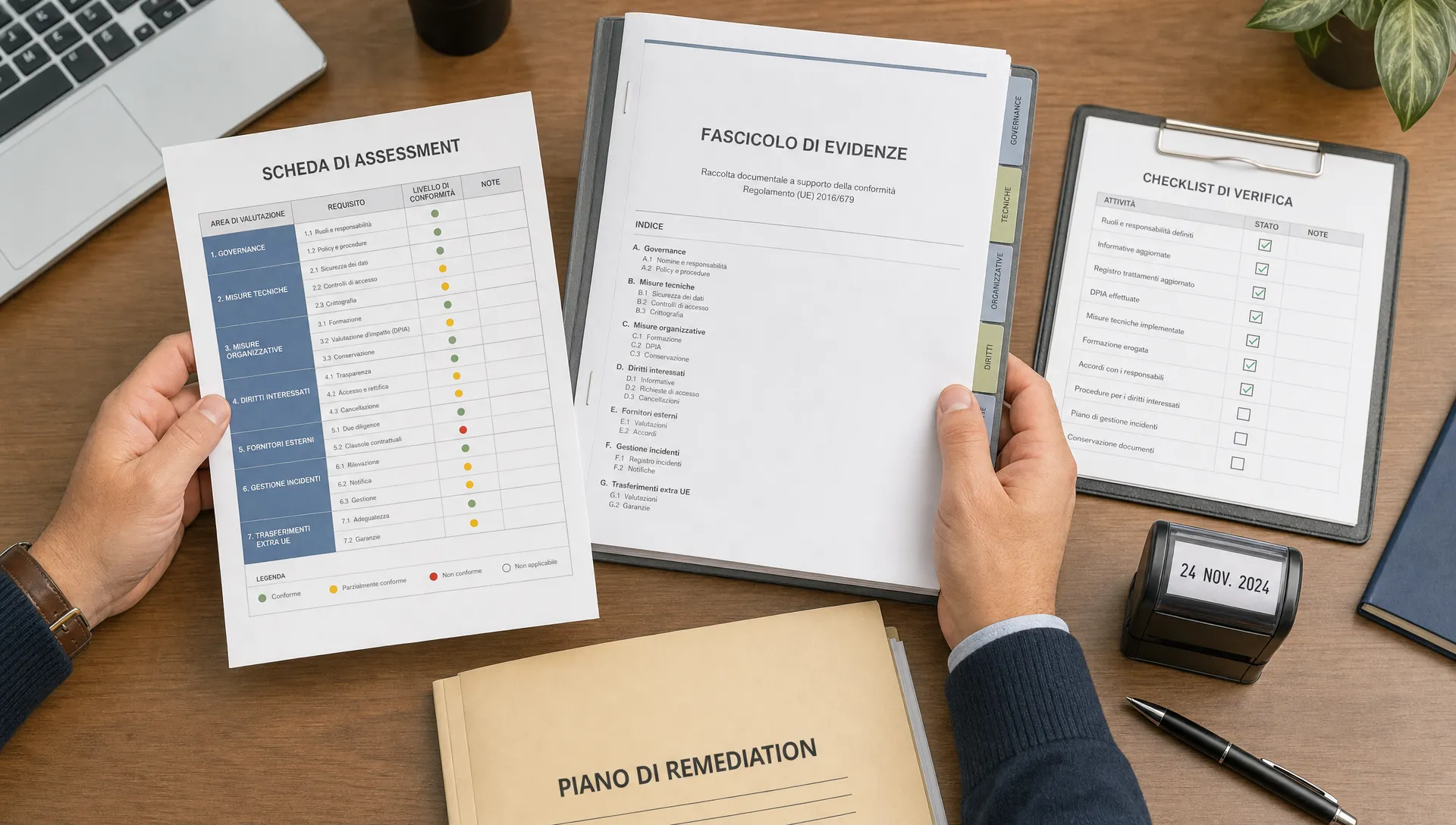
A privacy assessment should do more than confirm that policies and procedures exist. To be audit-ready, it must show which processing activities were reviewed, the risks identified, the controls in place, who owns them, and the verifiable evidence that those controls operate over time.
This guide is practical and operational. It doesn’t replace legal advice on legal bases, notices, contracts or controller decisions. Instead it explains how to assemble an evidence pack that’s traceable, verifiable and defensible in front of a DPO, internal auditor, consultant or stakeholder.
The purpose of evidence in a privacy assessment
Regulatory frameworks such as the GDPR require controllers to be able to demonstrate compliance, not just to comply. That means an assessment that only produces statements without supporting evidence is weak in audit scenarios.
A robust privacy assessment answers four simple questions for every item under review: what was assessed, by what criteria, who performed the check, and what verifiable results were produced. Missing any of these elements makes it difficult to demonstrate accountability.
Organize evidence by control area rather than by random document folders. Each piece of evidence should have an owner, date, version, link to a requirement and a remediation status if gaps were found.
Establishing perimeter evidence: scope, processes and data
Before collecting technical proof, document the scope of your assessment. A common mistake is to start from generic controls without being clear which processes, systems, suppliers, categories of data subjects and data flows are included.
Minimum context evidence should include: the record of processing activities (RoPA), a data flow map, the list of systems in scope, a data classification aligned to the RoPA and a clear mapping of roles (controller, processor, authorized users). If any part of the environment is excluded from the assessment, record why and when.
Useful perimeter evidence and how to make it auditable:
- Processing record excerpt or system extract that links system, owner, purpose and categories of personal data.
- Roles matrix that shows controller, processor and authorized roles with source, validation date and approver.
- Versioned data flow diagrams that are traceable to the actual systems and interfaces.
- Data classification taxonomy consistent with controls and the RoPA.
- Scope exclusion notes with rationale and date.
Primary sources (system exports, contracts, approved tickets or formal decisions) are stronger than retrospective descriptions.
Evidence for technical and organisational controls
Once the perimeter is defined, prove that controls are not just documented but operational. GDPR Article 32 requires appropriate technical and organisational measures — your evidence should reflect their implementation and ongoing operation.
Common control areas and evidence examples:
- Access management: access review reports, group exports, and approved privilege requests.
- Logging and auditability: configured logging settings, retention policies and examples of correlated logs used in investigations.
- Encryption and backup: configuration snapshots, backup test reports and restoration validation.
- Account lifecycle: records of account provisioning/deprovisioning, dormant account remediation.
- Data retention and deletion: retention rules, deletion requests, and proof of data disposal.
Always link each control to the requirement it mitigates, the specific risk, and the operational owner. For guidance on building readable, verifiable logs, see AuditReady’s primer on audit trails (/en/blog/audit-trail-gdpr).
Risk assessment and DPIA evidence
Risk assessment connects perimeter, controls and decisions. Your assessment should show why a processing activity is low, medium or high risk, the scoring method used, the sources consulted, participants and the residual risk after controls.
When processing poses a high risk to individuals’ rights and freedoms, a Data Protection Impact Assessment (DPIA) is required. The DPIA document alone is not sufficient as evidence: include the scoring method, participants, meeting notes, the mitigation measures proposed, deadlines and subsequent verification.
If the DPIA concludes that a risk is acceptable, record who made that decision and the rationale. For regulatory context on DPIAs, consult authoritative guidance such as national data protection authorities and the European Data Protection Board.
Suppliers, processors and international transfers
External suppliers often perform core processing tasks. Simply stating that a supplier is “managed” is insufficient in audit. Evidence should show the supplier was identified, assessed, contracted and monitored.
Operational supplier evidence includes:
- Supplier catalogue with criticality and ownership.
- Copies of contracts or Data Processing Agreements (DPAs) and documented instructions.
- Due diligence results, required controls and any third-party attestations.
- Records of sub-processors and periodic re-assessments for critical suppliers.
For transfers outside the EU/EEA, include the transfer mechanism used (e.g., SCCs), the transfer assessment performed and any additional safeguards applied. For more on transfers, see the related guidance (/en/blog/data-transfers-outside-eu).
Assign a clear lifecycle state to each supplier in scope: approved, approved-with-remediation, under-review, suspended or out-of-scope. A status without evidence is not audit-ready.
Incident handling, data subject requests and remediation evidence
An assessment gains credibility when it includes evidence of real-world operation: incidents, data subject requests, findings and remediation show whether governance works when things happen.
Incident evidence should include an internal register entry, classification of the event, timeline, impact analysis, notification decision and communications, corrective actions and closure verification. The documentation must allow reconstruction of facts, timing and responsibilities in line with GDPR requirements.
For data subject requests keep the intake channel, receipt date, requester verification steps, request type, owner, outcome, response timing and produced records. Rejections or limitations must be justified and attributable to an authorized decision-maker.
Remediation items should be tracked as discrete records: finding, linked risk, corrective action, owner, due date, status, evidence of completion and validation. This converts findings into a verifiable control cycle rather than leaving them as comments in a report.
Building a defensible evidence pack
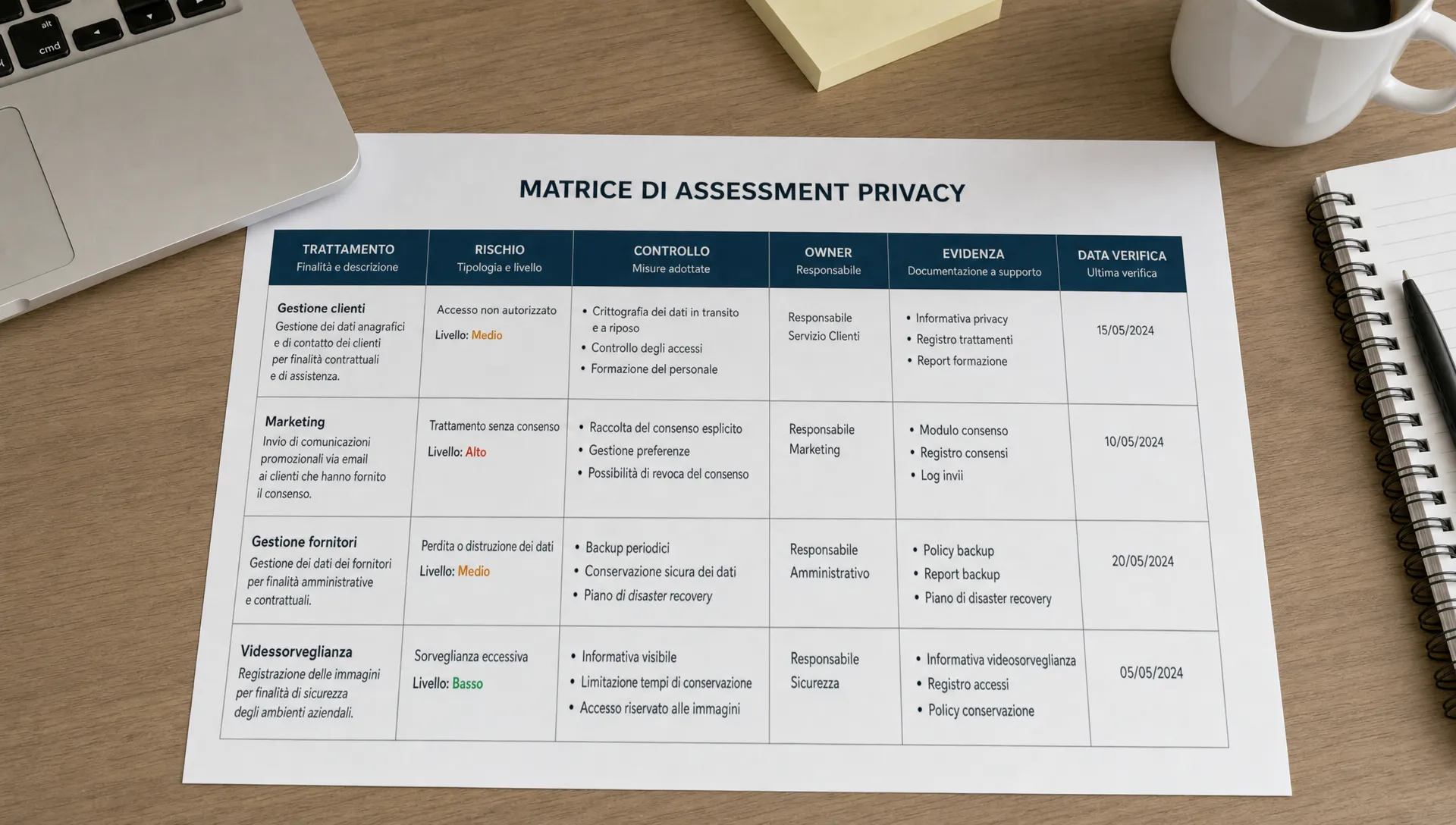
An evidence pack is useful only if it’s easy for an auditor to trace from requirement to control to evidence to owner. A simple traceability matrix is the most effective format.
Recommended fields for the matrix:
- Requirement or control: what is being verified.
- Processing activity or system: context for the control.
- Owner: operational responsibility.
- Evidence: link to the supporting artifact.
- Date and version: shows currency of the evidence.
- Result: conforms / partially conforms / non-conformant / not applicable.
- Remediation status: actions, deadlines and closure evidence.
- Audit trail: history of changes, approvals and handovers.
Compare this matrix to audit-evidence best practices when multiple frameworks or teams share controls (/en/blog/audit-evidence).
Common pitfalls to avoid
- Collecting documents without mapping them to controls. A policy is not proof that controls were executed.
- Failing to assign owners. Unowned evidence ages and becomes unverifiable.
- Confusing document volume with compliance. Better to have a few strong, current, linked proofs than a large, ungoverned archive.
- Not tracking remediation. An open finding is manageable if tracked; it’s a problem when there’s no follow-up evidence.
Quick checklist for the privacy team
Before closing an assessment file, verify these operational items (this is not legal advice):
- Processing scope documented and approved
- RoPA, data flows and systems linked
- Roles and suppliers recorded with verifiable sources
- Controls mapped to risks and supported by evidence
- DPIA or documented justification when applicable
- Incidents, requests and remediations recorded with owners and dates
- Evidence versioned, accessible and linked to requirements
- Audit trail for changes, approvals and closures
If something is missing, record it as a gap, assign remediation and keep evidence of the remediation plan.
FAQs
Is a privacy assessment the same as a DPIA? No. A DPIA is a specific impact assessment required by GDPR in particular circumstances. A privacy assessment is broader and can include scope, controls, suppliers, incidents, requests and remediation evidence.
What is the single most important piece of evidence? There is no single universal artifact. Auditors look for the chain: requirement → control → owner → evidence → date → result → follow-up. Isolated technical proof or a lone policy is usually insufficient.
How often should the evidence pack be updated? Update frequency depends on risk and change. Critical processes, new suppliers, incidents, application changes and open findings should trigger updates rather than relying solely on annual reviews.
Who should own privacy evidence? Ownership depends on the control. The DPO or privacy lead can coordinate, but most artifacts come from IT, security, procurement, HR, legal or business owners. Make responsibility explicit.
From checks to an audit-ready package
To turn controls, owners, evidence, versions and remediation into an audit-ready package, consider tools that centralise GDPR evidence in a single operational workspace. AuditReady helps teams organise evidence, link it to controls and maintain an auditable trail of decisions and remediation (/auditready/lp/gdpr).
audit-ready evidence pack demo / not legal advice