

A traceable approach to data governance goes beyond well-written policies. It requires the ability to reconstruct why a decision was taken, who approved it, what residual risk was accepted and which compensating controls were put in place. In practice, many compliance gaps appear in operational gray areas: temporary exceptions, delayed remediations, emergency access, non‑standard processing and third‑party workarounds.
This article is practical, not legal advice. It proposes a simple model to document decisions, exceptions and risk acceptances so they are verifiable during internal audits, second‑party reviews or regulator inspections under frameworks such as GDPR, NIS2, DORA, ISO 27001 and the AI Act.
Why decisions and exceptions are the weak link in data governance
Standard processes are usually well documented. The trouble starts when reality forces deviations: a system needs to stay online beyond an agreed date, a control is not yet in place, a vendor hasn’t delivered paperwork, or a team urgently needs wider access to personal data. In those moments governance must produce a readable trail — not an ad hoc chat message or a scattered email.
Auditors should be able to follow a clear sequence: request, impact analysis, decision, approver, compensating controls, expiry, review and closure. The EU General Data Protection Regulation (GDPR) codifies accountability: the data controller must be able to demonstrate compliance with applicable principles. NIS2 and DORA have different wording but the operational need is similar: show that risks, controls, incidents and decisions are managed with clear responsibility and verifiable evidence.
What to track: decisions, exceptions, derogations and risk acceptances
Different operational choices carry different weight. Distinguish routine decisions from exceptions that temporarily alter a control, a process or a responsibility.
- Decision: a documented choice between alternatives (for example, launching a new data flow, changing an owner, or updating a record). Evidence should show the options considered and the chosen outcome.
- Exception/derogation: a temporary authorization to deviate from an established rule, usually because of technical constraints, operational urgency or third‑party dependencies.
- Risk acceptance: an explicit choice to tolerate a residual exposure within approved limits. This requires a clear scope, rationale, review date and an accountable approver.
Minimum evidence examples:
- Decision — example: approval of a new data transfer flow. Evidence: approved ticket or minutes, impact analysis, owner, decision date.
- Derogation — example: temporary access beyond standard roles. Evidence: motivated request, approval, expiry, compensating control.
- Risk acceptance — example: postponed remediation for a technical blocker. Evidence: risk assessment, approver with authority, remediation plan, review schedule.
- Vendor exception — example: service started despite incomplete documentation. Evidence: partial due diligence, contractual conditions, follow‑up deadline.
- Remediation closure — example: finding resolved after implementing a control. Evidence: technical test results, owner validation, final status.
The decisions registry as the backbone of auditable governance
A decisions registry must be a living system, linked to controls, processes, risks, processing activities and vendor records. A static spreadsheet kept out of date loses evidentiary value and makes ownership unclear.
Each relevant decision should have a unique identifier and a clear linkage to the control or requirement affected. For example, a derogation on privileged access must reference the access control, the related risk record, the affected system and the revocation date.
Recommended minimum fields
Make these fields mandatory and structured to enable repeatable verification:
- Decision/derogation ID — unique and auditable reference.
- Scope — which data, systems, processes or vendors are involved.
- Rationale — a specific, verifiable reason (not just “business urgency”).
- Operational owner — who executes and maintains the control.
- Approver — who authorizes the decision and holds appropriate authority.
- Residual risk — the remaining exposure, linked to a risk register when available.
- Compensating control — temporary mitigation that is measurable or verifiable.
- Expiry/review date — when the exception ends or the decision is reviewed.
- Linked evidence — tickets, logs, minutes, exports, screenshots, reports.
For guidance on packaging evidence, see our article on audit evidence practices at /en/blog/evidenze-di-audit (note: article available in English at the AuditReady blog).
Managing exceptions without losing control
A properly managed exception is not a control failure; it’s a traceable, temporary solution. It becomes problematic when approved without an expiry, without risk assessment or without a remediation plan.
Exceptions should follow a consistent workflow: request, risk assessment, approval, compensating control, monitoring, review and closure. Every step must leave verifiable evidence.
Seven‑step operational flow
- Request — a documented description and scope (ticket or digital form).
- Assessment — impact on data, systems, services and obligations (risk sheet, DPIA if needed).
- Approval — explicit decision recorded with role and date.
- Compensation — temporary control or alternative measure with testable evidence.
- Monitoring — logs, alerts and periodic checks to ensure the exception remains within scope.
- Review — confirm, modify or revoke the exception; record the outcome.
- Closure — return to standard control or formalize an accepted residual risk; provide final evidence.
The crucial failure mode is lack of closure. Organizations often open exceptions but fail to prove when standard controls were restored, which creates accumulated exceptions and undermines control frameworks.
Evidence and audit trail: making decisions verifiable
A decision without context is not audit‑ready. Storing just the final approval does not show what information or alternatives were evaluated at the time. An audit trail must capture events, actors, timestamps, document versions and state changes.
A robust audit trail answers four questions: who did what, when, on which object and with what outcome. If an exception is extended, the extension must appear as a new auditable event rather than silently changing the original expiry.
Organizational metadata — owner, approver, linked control, risk rating, expiry, attached evidence and remediation status — matters as much as technical logs. For more on reconstructing responsibility from logs, see best practices at /en/blog/audit-trail-best-practices.
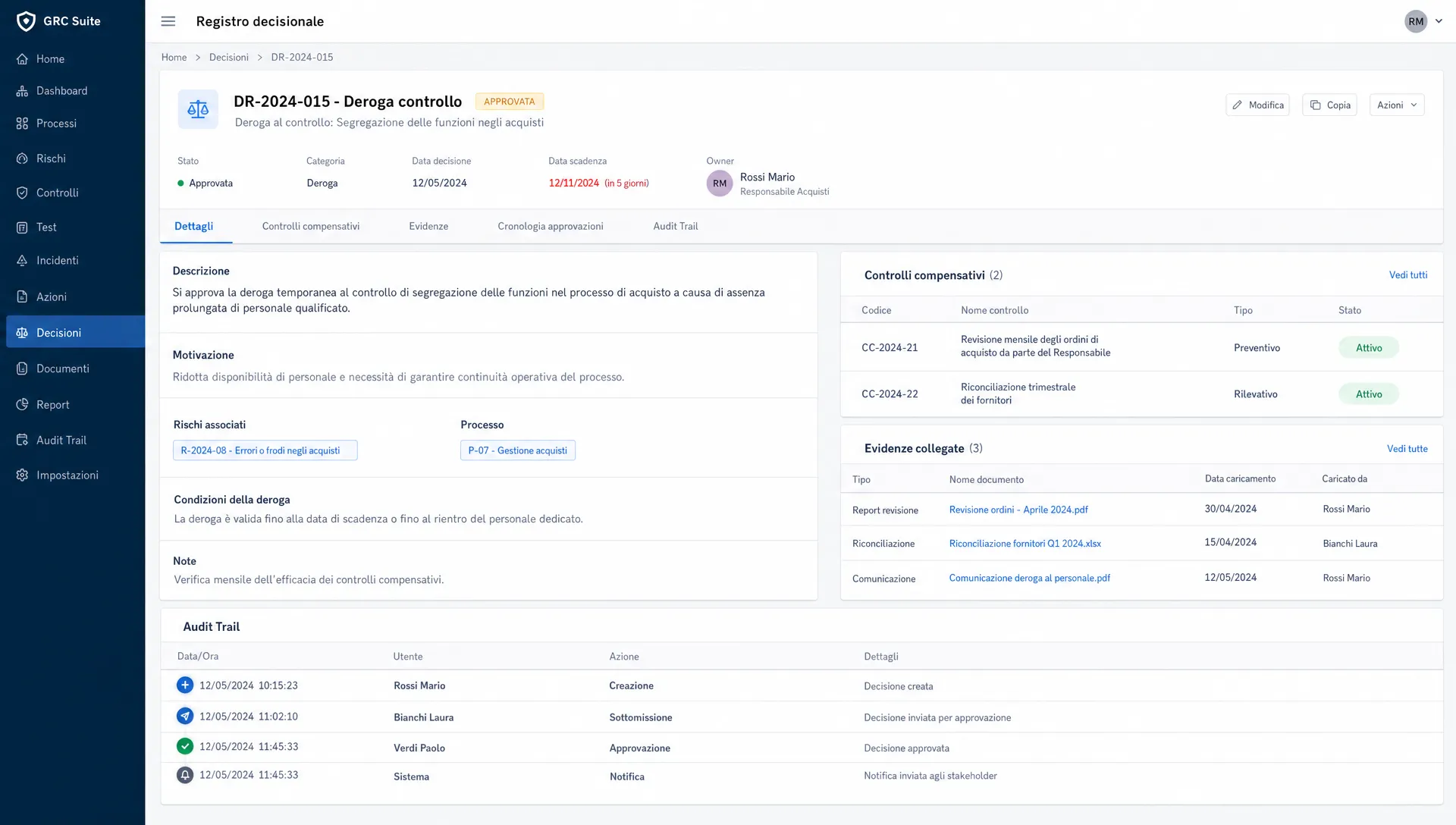
Building an evidence pack for each decision
An evidence pack is not a loose collection of files; it’s an organized bundle that proves a decision from start to finish. For a temporary access exception, an evidence pack should include the request, the risk assessment, approval, the temporary configuration, monitoring logs, review notes and revocation evidence.
When preparing for a GDPR or other regulatory audit, link these packs to your wider compliance program so decisions, controls and remediations are not treated as isolated items. See related guidance at /en/blog/gdpr-audit-conformita-dimostrabile.
Mapping decisions to GDPR, NIS2, DORA and the AI Act
A decisions registry should map each decision to the relevant internal requirement or regulatory obligation. This is not legal advice — it’s an operational mapping so auditors can see why a choice matters in a compliance context.
Different frameworks focus on different angles:
- GDPR: new processing operations, registry updates, access approvals, retention and technical/organizational measures. Useful evidence: ROPA, DPIAs, access logs, versioned privacy notices.
- NIS2: exceptions on security controls, vulnerability management or continuity measures. Useful evidence: risk registers, remediation plans, control reports and incident response records.
- DORA: deviations affecting ICT resilience, testing or critical ICT suppliers. Useful evidence: ICT risk logs, test reports, supplier monitoring and remediation plans.
- AI Act: decisions on datasets, data quality, human oversight and system changes for high‑risk AI systems. Useful evidence: dataset documentation, quality assessments, change logs and control evidence.
The goal is not to quote regulations verbatim but to show a clear, auditable link between requirement, control, decision and proof.
Metrics to know whether governance is under control
Metrics should reveal operational debt, not just decorate a dashboard. Trackable indicators include number of open exceptions, average duration, expired exceptions, repeated extensions, decisions without an owner, overdue remediations and percentage of evidence rejected during review. Target thresholds should be tailored to your sector, risk appetite and complexity.
Second‑line checks should validate process adherence rather than redo first‑line work. A quarterly sample can verify whether each exception has a rationale, approver, risk rating, expiry and closure evidence. Findings should drive corrective actions that address root causes (missing alerts, unclear owners, insufficient approver training, or permissive workflows).
Common mistakes to avoid
- Confusing approval with traceability: a signed approval alone doesn’t show that the decision was informed, limited and monitored.
- Treating exceptions as informal notes without links to risks, controls and expiry dates.
- Overwriting records instead of versioning: changing scope or expiry should create a new event or version to preserve history.
- Not separating owner and approver: owners execute and maintain evidence; approvers assume decision responsibility. If these roles always coincide, independence is lost for higher‑risk choices.
Pre‑audit checklist
Before an audit, don’t just export a list of exceptions. Confirm that every record tells a complete, verifiable story. Use this quick checklist:
- Every decision/exception has a unique ID and opening date.
- Scope clearly identifies data, systems, processes, vendors or controls.
- Operational owner and approver are recorded with recognizable roles.
- Rationale is specific and evidence‑based.
- Residual risk is documented or linked to a risk register.
- Exceptions include expiry/review dates and compensating controls.
- Extensions are separate auditable events.
- Closure includes final technical evidence or owner validation.
- Evidence is versioned and linked to the relevant control.
- Open findings have remediation owners and target dates.
This checklist is operational and does not replace legal evaluation, but it helps prepare a defensible, audit‑ready evidence package.
Frequently asked questions
What’s the difference between an exception and a risk acceptance?
- An exception permits a temporary deviation from a rule or control. A risk acceptance formalizes tolerating a residual exposure within an approved perimeter. Both need owner, rationale, expiry, evidence and review.
Is an email approval sufficient for audit?
- It may serve as supplementary evidence, but it’s better to record the decision in a structured registry that captures full context, risk, approver role, related controls, expiry and remediation status.
How long should evidence be retained?
- Retention depends on applicable obligations, internal policy, processing type, contract terms and risk. Define and apply retention rules consistently, and avoid untracked deletions.
Who should approve a data exception?
- The approver must have authority proportional to the impact and risk. Depending on the situation, this may involve IT, security, compliance, DPO, risk owners, business owners or legal — as set by your internal governance model. This article does not provide legal advice on mandatory approvers.
How do I demonstrate that data governance is under control?
- By linking decisions, controls, risks, owners, audit trails and evidence so an auditor can verify not only that policies exist but that exceptions were handled, monitored and closed.
If you need help packaging decisions, exceptions, evidence and remediation into an audit‑ready evidence pack, evaluate AuditReady for GDPR and related compliance programs at /auditready/lp/gdpr.
audit-ready evidence pack demo / not legal advice