Structured audits
Plan activities, timeframe, scope and requirements for GDPR, NIS2, DORA, ISO 27001, AI Act or Model 231.

Operational loop
Define scope, objectives, standards and deadlines. Connect controls, systems, assets, policies and evidence without reconstructing the context for every review.
Plan activities, timeframe, scope and requirements for GDPR, NIS2, DORA, ISO 27001, AI Act or Model 231.
Map controls to frameworks, owners, policies, systems, assets, requests and evidence.
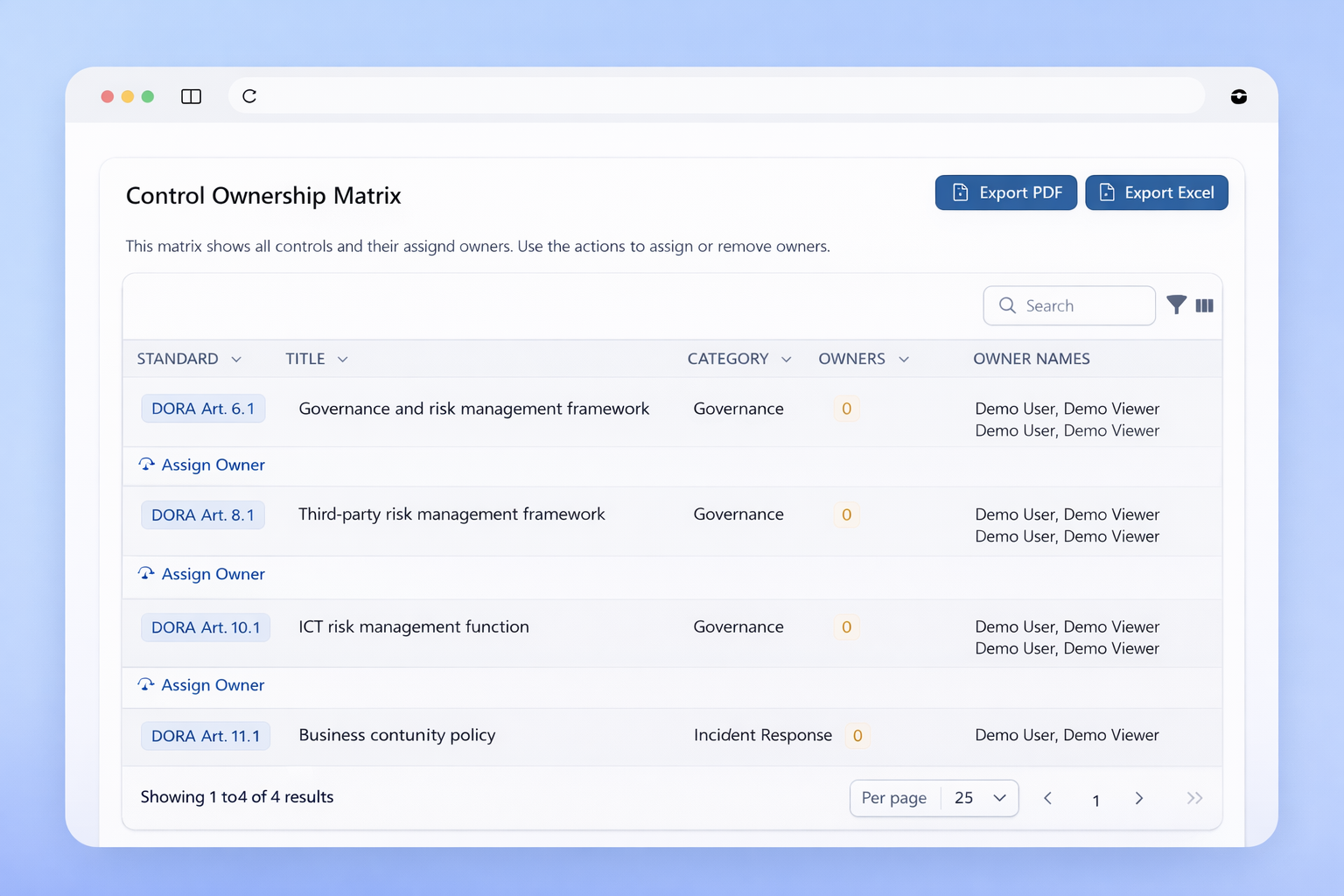
Use Gap Snapshot and the ownership matrix to see what is missing and who needs to act.
Roles and permissions are built around capabilities and can be enabled or restricted per module and framework, per tenant.
Create the audit with standards, timeframe and a responsible owner.
Map library controls to policies, systems, assets and evidence requests.
Use the ownership matrix and Gap Snapshot to see what is missing.
Request missing evidence and include the audit in the Audit Day Pack when it is ready.
An operational repository for documents and proof: not an isolated archive, but the connection point between a control, policy, supplier, audit and register.
ExploreCentralise findings from audits, incidents, tests, privacy or manual entry and keep severity, owner, deadline, action and closure proof together.
ExploreAudit Day Pack 2.0 gathers the audit scope into a background-generated ZIP, structured for reviewers and readable by external systems.
ExploreYes, an audit can reference several standards (GDPR, NIS2, DORA, ISO 27001, AI Act, Model 231), and controls stay mapped to the relevant frameworks.
Gap Snapshot freezes the state of your controls at a point in time, highlighting what lacks evidence or an owner.
Access is governed by roles and capability-based permissions, which can be enabled per module and framework at the tenant level.