
A well-structured meeting minutes template is not administrative overhead; it is a critical governance control. In regulated environments, these documents provide auditable evidence of an organization's decision-making process, risk assessment, and oversight functions. They form a foundational component of a compliance framework.
Why Standardised Minutes Are a Critical Governance Control
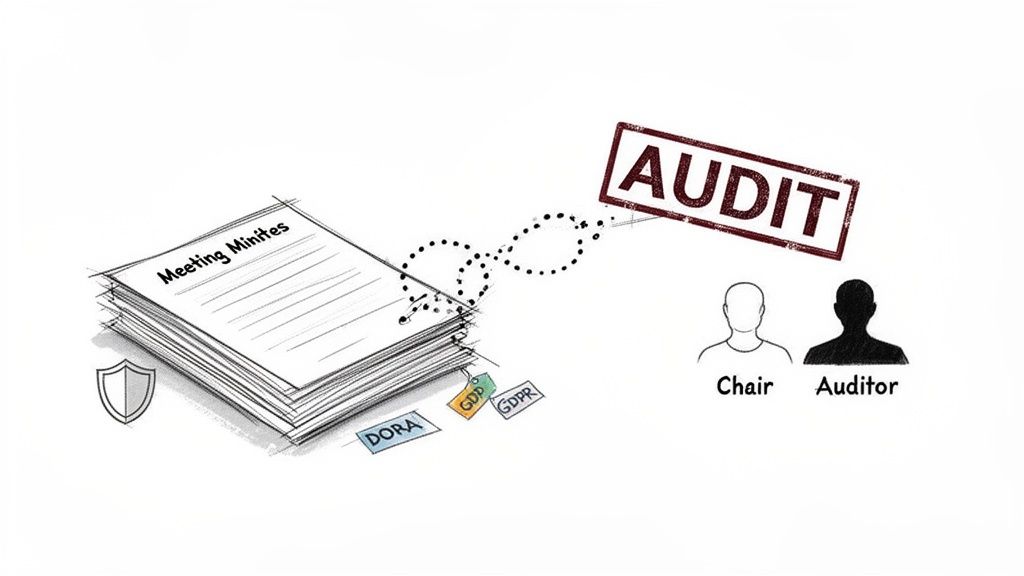
In regulated sectors, meeting minutes transition from informal notes to indispensable evidence. They provide a traceable, chronological record that demonstrates to auditors how an organisation identifies, discusses, and manages its risks and responsibilities. Without a standardised approach, documentation can become inconsistent, incomplete, or ambiguous, creating significant vulnerabilities during an audit.
From a governance perspective, a meeting minutes template exists to enforce discipline and consistency in documentation. It ensures every critical discussion—from a board meeting to an incident post-mortem—is captured with the same level of rigour. This uniformity is necessary to demonstrate mature governance under frameworks like DORA or GDPR.
The Risks of Inconsistent Documentation
Inconsistent minute-taking introduces procedural risk. When documentation quality varies between meetings, it signals a lack of systemic control over governance processes. An auditor is likely to interpret this as a procedural weakness, which may cast doubt on the integrity of the entire decision-making framework.
The primary risks include:
- Failed Audits: Incomplete or unclear minutes make it difficult to prove that required discussions occurred or that decisions were made with due diligence.
- Regulatory Penalties: For regulations that mandate clear oversight, such as DORA's requirements for ICT risk management, inadequate records can be treated as a direct violation.
- Lack of Accountability: Without a formal record of action items, assigned owners, and deadlines, accountability becomes unenforceable, and critical tasks may be overlooked.
A meeting minutes template is a control that mandates the capture of specific data points. Its purpose is not to prescribe discussion topics but to ensure the outcomes of those discussions are recorded in a way that satisfies regulatory scrutiny and internal governance.
This structured approach transforms minutes from a reactive task into a proactive governance tool. A well-designed template serves as a first line of defence in proving that an organisation operates with foresight and accountability. It provides the concrete audit evidence needed to validate a compliance posture. Standardisation builds a defensible history of responsible governance.
Designing a Defensible Meeting Minutes Template
Meeting minutes are not merely a record of discussion; for an audit, they are evidence of governance in action. A defensible template is structured to be so clear and traceable that it can withstand scrutiny. It must provide an unambiguous account of how and why decisions were made, beginning with a consistent, non-negotiable framework.
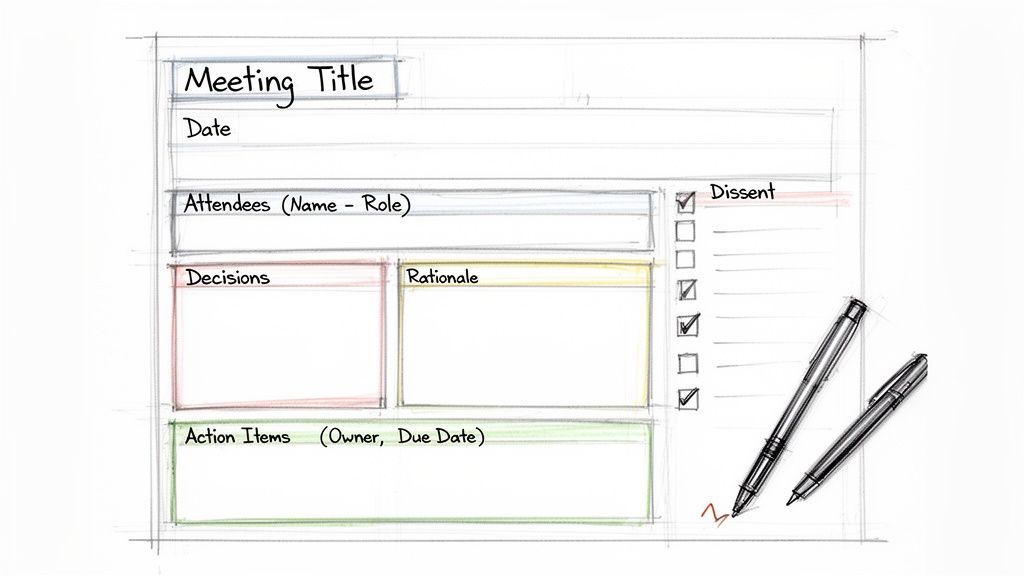
This foundational information frames the substance of the meeting and confirms that the appropriate stakeholders were present. An auditor will verify these details first to establish the meeting’s legitimacy before examining the outcomes.
Non-Negotiable Fields
An audit-ready template begins with essential metadata. These fields provide the context an auditor needs to verify a meeting's validity.
- Meeting Title & Purpose: Be specific. "Steering Committee: Q3 Cyber Risk Review" is functional; "Steering Committee Meeting" is not.
- Date & Time (with Time Zone): Precision is critical for incident response meetings or sessions with distributed teams. Include both start and end times.
- Attendees & Absentees: List each person's full name and role. Noting who was absent is as important as listing who was present.
- Meeting Chair / Facilitator: Identify the individual responsible for leading the discussion.
These are not just procedural formalities; they are the first layer of evidence, proving that a formal, structured discussion took place with the required participants.
Essential Fields for an Audit-Ready Template
To build a defensible record, every field in the template must serve a clear purpose for both internal governance and external audits. The table below outlines the most critical components.
| Field Name | Purpose in Governance | Audit Significance |
|---|---|---|
| Meeting Title & Purpose | Sets clear expectations and focus for all participants. | Confirms the meeting's relevance to specific governance areas (e.g., risk, strategy). |
| Date, Time & Attendees | Establishes a formal record of who was present and when. | Verifies quorum and the presence of required stakeholders for key decisions. |
| Decisions Made | Provides an unambiguous record of all conclusions reached. | Offers a clear, traceable log of formal resolutions. Vague records are an audit flag. |
| Rationale for Decisions | Documents the "why" behind each decision, including risks and alternatives considered. | Demonstrates due diligence and a structured decision-making process. |
| Action Items (with Owner & Deadline) | Assigns clear accountability and timelines for follow-up tasks. | Shows that decisions lead to concrete actions, proving the governance cycle is active. |
| Dissenting Opinions | Records formal objections to show robust debate and risk consideration. | Proves that alternative viewpoints were heard and considered, a hallmark of mature governance. |
A template built around these fields does more than capture notes; it enforces a structured, accountable approach to every discussion, making the governance process inherently more auditable.
Documenting Decisions, Not Just Discussions
The substance of the minutes lies in the documentation of decisions, the reasoning behind them, and the actions they trigger. Vague statements like "The committee decided to proceed" are insufficient. An auditor needs to see the deliberative process: why was a particular decision made, what alternatives were considered, and why were they rejected? This is especially critical for matters involving significant risk or strategy.
The objective is to create a record so clear that an external party, with no prior context, can understand not only what was decided but why it was the most prudent course of action at that time.
Inadequate documentation is also an operational issue. Disorganised meetings and weak record-keeping contribute to inefficient decision-making processes, turning a compliance tool into strategic infrastructure.
Capturing Action and Dissent
A robust template must systematically capture two outputs that demonstrate accountability: action items and dissenting opinions.
For every action item, the template must require three components:
- A specific task: What, exactly, needs to be done?
- An assigned owner: Which single individual is accountable for its completion?
- A firm deadline: When is it due?
Recording dissent is equally important. If a member formally objects to a decision, the minutes must note their name and a brief, neutral summary of their reasoning. This demonstrates that the committee engaged in robust debate and considered all perspectives, which is a sign of strong governance. You can learn more in our guide to governance, risk, and compliance.
Adapting Your Template for Specific Governance Meetings
A single meeting minutes template is rarely sufficient for all governance functions. While a core structure ensures consistency, high-stakes meetings require specialised versions to capture the appropriate evidence. The goal is to augment a solid core structure with fields that address the unique requirements of a specific meeting type. This ensures all documentation is both high-quality and auditable.
The primary template should serve as a foundation. From there, specialised versions can be developed for recurring, critical meetings, such as board sessions or incident post-mortems. This approach provides a baseline of control while capturing the specific details an auditor will seek.
Customising for Board of Directors Meetings
Board meetings carry legal weight, and the minutes must reflect that formality. While standard fields remain necessary, the focus shifts to recording formal governance actions. An auditor reviewing board minutes seeks evidence of director due diligence.
The board meeting template must be modified to include:
- Formal Motions and Resolutions: Document the exact wording of any motion, who proposed it, and who seconded it.
- Voting Records: Record the outcome of every vote, noting whether it was unanimous or passed by a majority, as well as any abstentions or formal dissents.
- Executive Session Summaries: If an executive session occurs, the minutes should note its start and end times. A high-level, non-confidential summary of the topics discussed should also be included, as permitted by governance policies.
For a board, minutes are a legal instrument. Vague language like "the board agreed" is an audit red flag. The template should enforce precise phrasing, such as, "A motion was made by [Director Name] and seconded by [Director Name] to approve the Q3 financial statements. The motion passed unanimously."
Tailoring for Technical Incident Post-Mortems
An incident post-mortem is a forensic exercise focused on dissecting a failure to understand its root cause. The minutes must provide a clear, blameless, and traceable account of what went wrong. An auditor or regulator will review these documents to verify that the organisation learns from failures and implements corrective controls.
An incident post-mortem template requires dedicated sections beyond a standard meeting format to facilitate a proper root cause analysis.
Key additions should include:
- Incident Timeline: A detailed, timestamped sequence of events from detection to resolution, including key actions taken by the response team.
- Root Cause Analysis (RCA): A specific section documenting the technical and procedural factors that led to the incident, clearly stating the identified root cause(s).
- Corrective and Preventive Actions: A list of specific, measurable actions designed to prevent recurrence, each with a clear owner and a firm deadline.
This structure transforms meeting minutes from a simple record into a critical component of the incident management system. It provides irrefutable evidence that the organisation systematically identifies and remedies its own weaknesses.
Establishing Document Retention and Version Control Processes
A well-designed meeting minutes template is only effective as part of a larger system for managing the documents it creates. The processes for storing, retaining, and versioning these records are what turn meeting notes into auditable evidence. A secure, traceable lifecycle for every set of minutes is a non-negotiable governance control.
Secure Storage and Access Controls
Meeting minutes often contain sensitive strategic, financial, or technical data. They must be stored in a controlled environment where access is managed on the principle of least privilege. A general-purpose shared drive is insufficient.
A dedicated system, such as a specialised platform or a highly restricted document repository, is required. Essential controls include:
- Role-Based Access Control (RBAC): Grant access based on a user's role (e.g., board member, incident responder), not on an individual basis.
- Immutable Audit Logs: The system must record every access, view, or modification attempt to create a clear chain of custody for forensic analysis or audits.
- Encryption at Rest: All stored minutes must be encrypted to protect the data from unauthorised access.
The flowchart below shows how a single core template can be adapted for different needs, each with distinct security requirements.
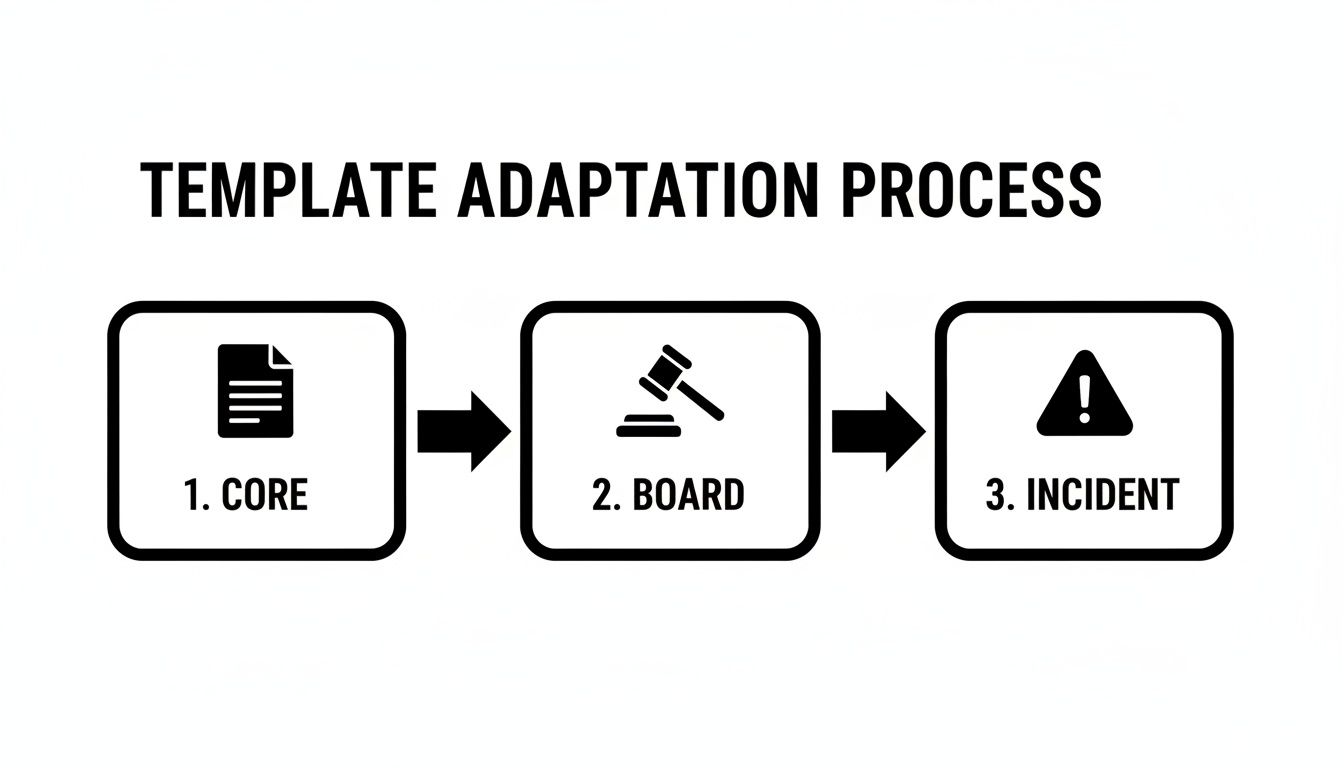
This illustrates that while the template's foundation is consistent, its specific application dictates its sensitivity, which in turn defines its storage and retention rules.
Retention Policies and Version Control
Retention policies must be linked to regulatory requirements (e.g., GDPR), industry standards, or legal obligations. Board meeting minutes are often considered permanent corporate records, whereas incident post-mortem documents might have a retention period tied to the lifecycle of the affected system.
The core principle of version control for minutes is immutability. Once a set of minutes has been formally approved, the original document must never be altered. It is a locked, historical record.
If an error is discovered after approval, the correct procedure is to create a new version or an addendum. This new document must clearly reference the original, detail the correction, and undergo its own formal approval process. This ensures auditors can see the complete, unaltered history of the record, including any subsequent amendments. Proactive and disciplined documentation can shorten audit duration.
For further information, explore our article on document management system software.
Actionable Templates for Governance and Incident Response
This section provides two downloadable meeting minutes templates designed to enforce the governance standards discussed.
The first is a general-purpose template suitable for steering committees, risk reviews, and board meetings. The second is a specialised template for technical incident post-mortems. Each is structured to capture auditable evidence and drive accountability.
General Governance Meeting Minutes Template
This template is designed for versatility across most formal governance meetings. Its structure compels clear documentation of decisions and their rationale, creating a defensible record for auditors.
[Download the General Governance Template Here - Link to PDF/Docx]
The following example demonstrates its use for a fictional Quarterly Risk Committee meeting. Note the specific action items and the neutral, factual tone.
Example Scenario: Governance Meeting
- Meeting Title: Q3 Cyber Risk Committee Review
- Date: 15 October 2024, 10:00 - 11:30 GMT
- Attendees: J. Smith (CISO, Chair), A. Patel (Head of IT), L. Chen (Compliance Officer)
- Decisions Made:
- Decision 1: The committee approved the proposed phishing simulation program for all employees, scheduled to begin in Q4.
- Rationale for Decisions:
- Recent threat intelligence indicates a significant increase in phishing attempts targeting the industry. The simulation is a necessary control to verify employee awareness. The alternative—mandatory training alone—was deemed insufficient without practical testing.
- Action Items:
- AI-001: A. Patel to finalise vendor selection for the phishing simulation platform. Owner: A. Patel. Deadline: 31 October 2024.
- AI-002: L. Chen to review the program's training materials for regulatory alignment. Owner: L. Chen. Deadline: 15 November 2024.
Incident Response Post-Mortem Template
This specialised template is for forensic analysis following a security or operational incident. Its structure enforces a systematic approach to root cause analysis and the assignment of corrective actions to prevent recurrence.
[Download the Incident Post-Mortem Template Here - Link to PDF/Docx]
The example below shows its application after a critical system outage. The focus is on a blameless, fact-based investigation that produces measurable improvements.
Example Scenario: Incident Post-Mortem
- Incident ID: INC-2024-045
- Incident Summary: Unplanned 45-minute outage of the primary customer payment gateway.
- Date: 16 October 2024, 14:00 - 15:00 GMT
- Root Cause Analysis:
- A configuration change deployed to production contained an undocumented dependency conflict. Pre-deployment checks in the non-production environment failed to replicate the specific load conditions that triggered the failure. The root cause is identified as an inadequate testing protocol for this class of change.
- Corrective & Preventive Actions:
- CPA-001: Implement a mandatory load-testing step in the pre-deployment pipeline for all gateway-related changes. Owner: Lead DevOps Engineer. Deadline: 01 November 2024.
- CPA-002: Update the change management policy to require a formal rollback plan for all critical service updates. Owner: Head of IT. Deadline: 15 November 2024.
Common Questions About Compliance Minutes
Formalising the documentation of meetings raises several practical questions in regulated environments where a defensible audit trail is non-negotiable.
How Detailed Should Meeting Minutes Be?
Minutes should be complete but concise. The objective is not a verbatim transcript, which can introduce legal risk by capturing subjective or out-of-context comments. The focus should be on the rationale behind a decision—the major points discussed, the final decision made, and the resulting actions. A useful guideline is to ask: could an external party read this record and understand the decision-making process without additional information? If so, the level of detail is appropriate.
Who Is Responsible for Taking and Approving Minutes?
The board or committee secretary typically drafts the minutes, but responsibility for their accuracy rests with all meeting participants, particularly the chairperson. The process must be structured.
A standard workflow is as follows:
- The secretary drafts the minutes promptly after the meeting concludes.
- The draft is circulated to all attendees for review and proposed amendments.
- At the beginning of the next meeting, the minutes are formally presented for a vote of approval.
- Once approved, they become an official, immutable part of the corporate record.
This approval process is what transforms notes into a legally recognised document.
The purpose of meeting minutes in a compliance context is to create an official, unambiguous record of governance. They must accurately reflect the actions and intent of the board or committee, providing a clear audit trail of due diligence.
Are Meeting Minutes Legally Binding Documents?
Yes. Once formally approved, meeting minutes are considered legal documents. They can be submitted as evidence in legal disputes or regulatory investigations to demonstrate that the organisation and its directors fulfilled their fiduciary duties. This is why precision is critical. Vague language, unrecorded decisions, or unclear action items create procedural weaknesses. A well-designed meeting minutes template is a primary defence, enforcing the capture of clear, factual information that can withstand scrutiny.