
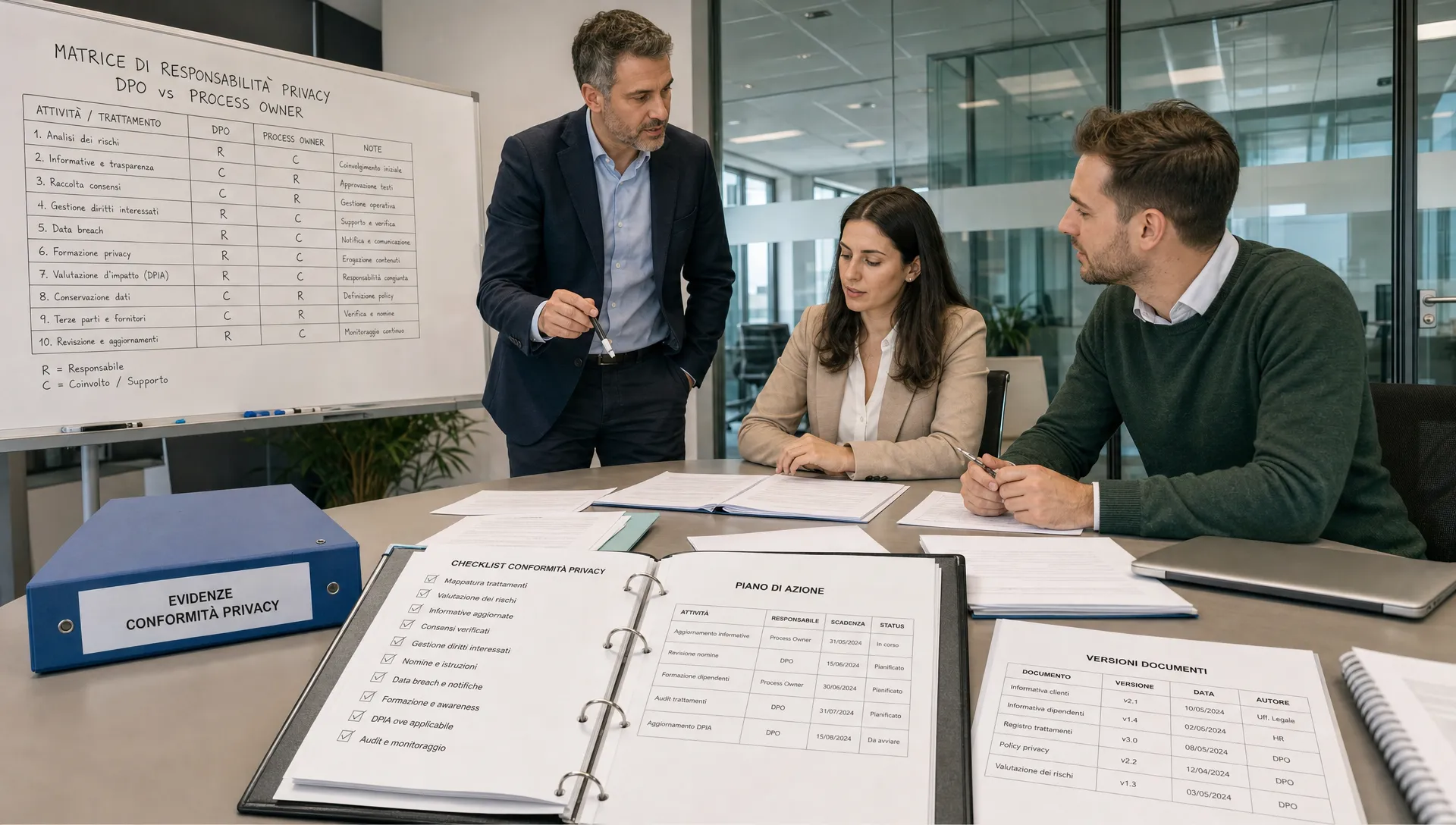
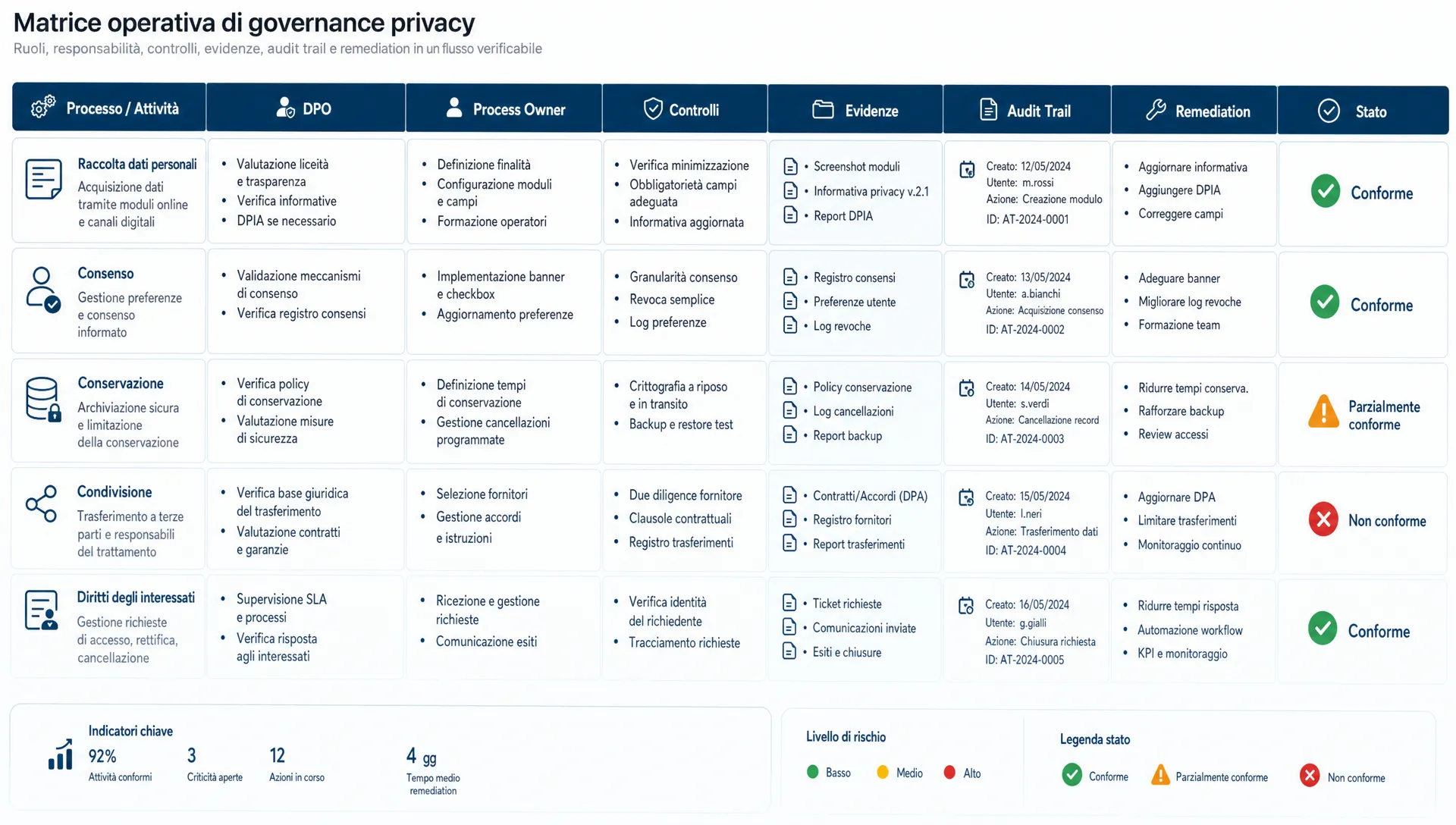
Privacy governance is not a static org chart or a document you file away. It’s the operational framework that shows who decides, who controls, who produces evidence, and who closes remediation for data processing activities. Good governance proves, in a testable way, who did what, when, based on which inputs and with which controls in place.
This article is practical in scope: it does not replace legal advice, but it explains how to build a recordable model that stands up to internal audits, management inquiries, and external inspections under GDPR and related frameworks like NIS2, DORA or ISO standards.
H2: Separate oversight, decision-making and evidence production
A common mistake is treating the Data Protection Officer (DPO) as the operational owner of all processing. Under Article 39 of the GDPR the DPO’s functions are information, advice, monitoring and cooperation with supervisory authorities; the role must remain free from conflicts of interest and have sufficient autonomy. For the official GDPR text, see the EU legal portal (EUR-Lex).
Process owners, by contrast, know the business process: goals, inputs, systems, suppliers, users and outcomes. If a processing activity concerns HR, marketing, customer service or finance, the corresponding process owner must explain purpose, data categories, systems used, recipients, active controls and residual risk.
A robust privacy governance model separates three layers:
- Oversight (who ensures compliance is monitored — typically the DPO and compliance functions)
- Operational decision-making (the process owner and management who run and resource the process)
- Evidence production and storage (the teams and systems that generate logs, reports, contracts and remediation records)
If these roles overlap without rules, audits degrade into a patchwork of emails, informal claims and implied responsibilities.
H3: The DPO’s role without making them an operational owner
In a healthy model the DPO is engaged at design-time (new or changed processing), during DPIAs, for incident response and for complex data subject requests. The DPO’s contributions should be recorded: advice issued, recommendations made, follow-ups requested and monitoring activities completed.
That does not mean the DPO must sign off every technical configuration or take operational responsibility. The DPO documents advice and tracks implementation; the process owner remains accountable for execution and management for resources and risk acceptance.
Evidence to preserve: when the DPO was consulted, what documentation they received, the opinions they issued, resulting action items and whether those actions were closed.
H3: The process owner as the control-owner
A process owner does not need to be a privacy law expert, but must understand how the process handles personal data. Operational questions they must answer include: which data enter the process, where they are stored, who accesses them, retention periods, which suppliers participate and what controls mitigate risks.
For verifiable governance, each material processing activity should have:
- A named owner or owning function (and a deputy)
- A review date
- A minimum set of controls
The process owner works with the DPO, Legal, IT Security and Procurement, but is responsible for maintaining the register, confirming evidence and closing remediation for their process.
H2: Use a clear RACI to avoid ambiguity
A RACI matrix (Responsible, Accountable, Consulted, Informed) is a useful, audit-friendly tool to clarify who does what. It’s not mandatory, but helps demonstrate that responsibilities are assigned to concrete activities rather than generic job titles.
Example activities and role allocations (adapt to your organization):
- Updating the records of processing: Process Owner (R), DPO/Legal/IT Security (C)
- Preliminary risk assessments: Process Owner (R), DPO/Legal/IT Security (C)
- DPIA execution and monitoring: Process Owner (R), DPO (C + monitoring), Legal/IT Security (C)
- Access control on systems: IT Security (R), Process Owner (C), Management (A for budget/priority)
- Incident response: Process Owner for the affected process (R), IT Security (R for technical triage), DPO/Legal (C)
- Remediation of privacy findings: Process Owner (R), DPO (monitoring), IT Security (R for technical fixes), Management (A for high-risk decisions)
Smaller organizations may combine roles; regulated entities often separate them more. Whatever the model, it must be coherent, approved and evidenced in practice.
Note: distinguish a RACI (who does what) from the evidence set used in an assessment (what was checked). For more on evidence mapping, see /en/blog/what-evidence-to-include-in-a-privacy-assessment.
H2: From the register to operational controls
A records-of-processing register should be a living control hub, not an annually updated spreadsheet. Each significant entry should link to an owner, a review cycle and verifiable controls. For example, an HR processing entry should point to the HR system, the access control list, the retention schedule, the supplier contracts and any DPIA performed.
Useful operational fields and sample audit evidence:
- Processing: purpose, data categories, systems, owner — evidence: approved register entry
- Legal basis and supporting documents: notices, procedures, contracts — evidence: current version and change history
- Control: description, frequency, responsible person, success criteria — evidence: logs, attestations, reports
- Risk: scenario, impact, likelihood, mitigations — evidence: risk assessment and review records
- Supplier: role, services, guarantees, DPA date — evidence: contract, annexes, periodic review notes
- Remediation: finding, owner, deadline, status, close evidence — evidence: ticket, approval and validation
Controls must be testable. “Manage access properly” is too vague; better: “quarterly review of administrative users on CRM, with process owner attestation and removal of obsolete accounts.” An auditor can then request the quarterly report, the user list, the remediation actions and approvals.
H2: Evidence and audit trail requirements
Credible privacy governance produces repeatable evidence, not only declarative statements. A useful audit trail lets you reconstruct the decision chain. For a register change it should show who proposed the update, who reviewed it, which fields changed, which version went live and what evidence supported the change.
Evidence should have at least four attributes: owner, date, version and linkage to the requirement or control. Without these elements an otherwise correct document can appear weak in audit because it does not demonstrate how it was produced.
A DPIA, for example, should show who completed each section, which systems were analyzed, DPO observations, accepted risks, remediation opened and their closure dates.
For guidance on structuring evidence sets, see /en/blog/audit-evidence-best-practices and /en/blog/evidence-of-audit.
H3: What an audit trail should show
An audit trail should allow reconstruction of the chain of actions and decisions. It’s valuable for data subject requests, breaches, DPIAs, supplier reviews, deletions and retention events. Good traceability reduces contradictory explanations and speeds up audit responses.
Audit trail best practices are operational, not purely technical. The DPO can monitor consistency, but owners and operational teams must feed the trail with timely, complete data.
H2: Make remediation measurable
Many privacy programs stall in remediation. Identifying gaps is easy; closing them and proving closure is what matters. Each finding needs a clear lifecycle: description, risk, owner, corrective action, deadline, required evidence, verification of effectiveness and closure approval. Extensions must be formally recorded.
Example: a marketing review finds internal users with unnecessary access to contact lists. Closing the finding requires the original list, the review criteria, the process owner’s decision, the actual removals performed, technical confirmation and final sign-off.
If residual risk cannot be immediately removed, management decisions must be documented with options, impacts and timelines. Any temporary acceptance should have an expiry and review date — this is evidence of accountability.
H2: Common mistakes to avoid
- Naming owners only on paper: if owners don’t receive reminders, validate evidence and act on remediation, the model fails.
- Using the DPO as a universal approver: this blurs advice and decision-making. DPO input must be visible; responsibility for processing remains with the controller and the process owner.
- Fragmenting privacy, security and procurement: many privacy risks come from systems, access rights, suppliers and retention. Siloes leave the register descriptive and controls ineffective.
- Failing to manage versions: policies, notices, DPIAs and contracts must show which version was in force at any point in time.
H2: 30-day operational checklist to get started
This is a practical, non-legal checklist to build a demonstrable governance model with real responsibilities between DPO and process owners.
- Days 1–5: Identify priority processing activities and assign process owners/deputies — output: list of critical processing with owners
- Days 6–10: Define a privacy RACI for register maintenance, DPIAs, incidents, suppliers and data subject requests — output: approved and communicated matrix
- Days 11–15: Link each priority processing item to a minimum control set and frequency — output: control catalog
- Days 16–20: Map required evidence for each control (format, source, validator) — output: evidence map
- Days 21–25: Open remediation tickets for known gaps — output: findings register with owners and deadlines
- Days 26–30: Run a small sample check (e.g., two processes) and collect evidence — output: report with collected proof and corrective actions
At the end of 30 days the goal is not perfection but to show a working governance model: roles assigned, controls producing evidence, and gaps entering a remediation cycle.
H2: How AuditReady helps without turning privacy into bureaucracy
If collecting evidence, linking it to controls and keeping a tamper-evident trace between DPO, process owners and auditors is the challenge, a centralized workspace can help. AuditReady centralizes evidence, controls, risks, incidents, privacy registers and audit packs with ownership, versioning and an audit trail.
For GDPR-focused preparation you can start from AuditReady’s GDPR audit pack page: /auditready/lp/gdpr. The tool doesn’t replace the DPO or legal advice; it helps organize and make verifiable the operational work needed to demonstrate compliance.
H2: FAQ
Q: Can the DPO also be the process owner? A: This requires careful consideration. The DPO must retain autonomy and avoid conflicts of interest. Operationally, it’s generally preferable to separate advisory/monitoring roles from direct process responsibility, documenting any justified exceptions.
Q: What is the minimum proof that a process owner is governing a processing activity? A: At minimum: a formal appointment, periodic reviews, associated controls, validated evidence and remediation actions tracked to closure. A name in the register alone is insufficient.
Q: Does the DPO have to approve every DPIA? A: The DPO must advise on and monitor DPIAs where required, but final decisions and resource allocations remain the responsibility of the controller and relevant process owners.
Q: How often should the privacy responsibilities matrix be reviewed? A: Review it whenever processes, systems, suppliers, roles or risks change. Many organizations also perform an annual review and document version and approval.
Q: How do you prove a privacy remediation is closed? A: Keep the original finding, assigned action, owner, deadline, evidence of the remediation, verification of effectiveness and a closure approval. If residual risk remains, record the management decision.
Note: This is operational guidance and not legal advice. For legal interpretation consult your DPO or external counsel.
audit-ready evidence pack demo / not legal advice