
Conducting VDR due diligence is not a file-sharing exercise; it is a controlled governance discipline. The objective is to manage and verify information with structured precision, ensuring data integrity, confidentiality, and a complete, auditable record of the due diligence process.
VDR Due Diligence as a Governance Discipline
For CISOs and compliance professionals operating within regulated frameworks like DORA or NIS2, treating VDR due diligence as a governance discipline is a baseline requirement. This approach positions the VDR not as a repository for files, but as a purpose-built environment for managing risk and verifying information. The primary functions are to ensure data integrity, maintain strict confidentiality, and produce an immutable record of every action. This requires moving beyond a simple checklist-based mentality to a systems-oriented approach.
Core Principles of a VDR Governance System
This discipline is founded on three core principles.
First is evidence. Each document uploaded is not merely a file; it is a piece of evidence supporting a specific claim or validating a control. It must be managed with procedural rigor, including clear versioning and contextual linkage to the diligence request it satisfies.
Second is traceability. An auditor must be able to trace any piece of evidence directly to the specific due diligence query, control, or policy it addresses. This linkage is what creates a defensible audit trail and demonstrates a mature control environment.
The final principle is accountability. Every action within the VDR—from upload to review to approval—must have clear, unambiguous ownership. Modern governance, risk, and compliance practices are built on this level of defined responsibility.
A Virtual Data Room should function as a controlled system for evidence management and risk assessment. Its primary role in due diligence is not storage but verification, establishing a single source of truth that is both secure and auditable.
The following process flow illustrates how a VDR operates when managed as a governance system.
The diagram clarifies that robust auditability is not an add-on feature. It is the outcome of systematically ensuring both the integrity and confidentiality of evidence throughout the entire diligence lifecycle.
Distinguishing Tools From Systems
It is critical to distinguish between using a VDR as a tool versus operating it as a system. A tool simply holds files. A system integrates processes, controls, and responsibilities to achieve a specific governance outcome.
A generic file-sharing platform is a tool. In contrast, a VDR configured with role-based access controls, dynamic watermarking, and immutable audit logs becomes a system engineered for the specific demands of VDR due diligence. This systemic approach provides the defensibility required in regulated industries, transforming a data room into a core component of a risk management framework. The focus shifts from merely sharing documents to proving compliance and managing risk with verifiable evidence.
Configuring VDR Security and Compliance Controls
Effective due diligence is not determined by the documents uploaded but by the control environment established before any data enters the Virtual Data Room. This initial configuration is the foundation of a defensible and controlled process. Errors at this stage compromise the integrity of the entire operation.
The cornerstone of VDR security is Role-Based Access Control (RBAC), which exists to enforce the principle of least privilege. Users must only be granted access to the information and functions strictly necessary for their role. In any regulated environment, this is a non-negotiable requirement.
From Broad Categories to Granular Control
A common error is to define user groups with vague labels like ‘Buyer’ or ‘Seller’. This approach lacks the necessary granularity and introduces unnecessary risk. A secure VDR demands roles defined by function and information need.
For example, an external legal team requires access to contracts and corporate records but has no operational need to view financial projections. Conversely, the internal finance team needs those projections but must be restricted from legally privileged communications. RBAC is the control that enables the implementation of these logical separations directly within the VDR's architecture.
This requires mapping every participant and their specific information requirements before issuing invitations. Defining who can view, who can download, and who is restricted to read-only access is the first line of defense against inadvertent data exposure and establishes clear accountability.
A VDR is a controlled environment, not a high-security folder. The configuration of access controls is what transforms a sharing tool into a system for secure, verifiable evidence management. The objective is to build a defensible perimeter before any sensitive data is introduced.
The adoption of VDRs is central to due diligence processes globally, driven by the need to mitigate risks, including human error. Controls like granular access permissions and strong authentication are designed for this purpose. Features like 256-bit AES encryption are now a standard baseline for any professional VDR platform, and are critical for meeting standards such as NIS2. The global VDR market continues to expand, as detailed by Fortune Business Insights.
Hardening the VDR Environment
Beyond RBAC, several other controls are essential for hardening the VDR against unauthorized access and data leakage.
Time-Based One-Time Password (TOTP) two-factor authentication (2FA) is a mandatory control. It verifies a user’s identity beyond a password, significantly reducing the risk of account compromise. Another effective control is IP whitelisting, which restricts VDR access to pre-approved IP addresses, blocking connection attempts from unauthorized locations.
Security must also extend to the documents themselves. Dynamic watermarking overlays every document with viewer-specific information, such as name, email, IP address, and access time. This serves as a deterrent to unauthorized sharing and ensures traceability if a document is leaked. For highly sensitive files, such as intellectual property or unredacted financial data, disabling all print and download functions is a necessary control. This ensures the information remains within the secure VDR environment.
These controls work in concert to create a secure, multi-layered environment.
Essential VDR Security Controls and Their Purpose
This table outlines the fundamental security controls for a VDR, explaining their function and the specific risks they mitigate during due diligence.
| Control | Purpose | Risk Mitigated |
|---|---|---|
| Granular RBAC | Enforces the principle of least privilege by assigning permissions based on user function. | Prevents unauthorized access to sensitive data categories by internal or external users. |
| Mandatory TOTP 2FA | Adds a second layer of identity verification beyond a password. | Protects against account compromise resulting from stolen or weak credentials. |
| IP Whitelisting | Restricts VDR access to a pre-approved list of IP addresses. | Blocks access attempts from unauthorized networks or geographic locations. |
| Dynamic Watermarking | Imprints user-specific information on all viewed or downloaded documents. | Deters unauthorized sharing and provides traceability if a document is leaked. |
| Disable Print/Download | Restricts users to view-only access for specific high-sensitivity documents. | Prevents the physical or digital exfiltration of the most critical information. |
By implementing these controls systematically, an organization can build a robust security posture. Each control addresses a different risk vector, and together they create a defensible VDR environment prepared for the scrutiny of VDR due diligence.
Organising Evidence for Clarity and Traceability
A VDR is a system for presenting a coherent and auditable trail of evidence, not just a storage location for documents. The effectiveness of due diligence depends not on the volume of information shared, but on how clearly it is structured.
The most effective method is to structure the VDR to mirror the due diligence checklist or the control framework under assessment. For an ISO 27001 audit, the VDR's primary folders should map directly to the Annex A controls. This establishes an immediate, logical structure that allows reviewers to locate required evidence efficiently. This ensures every policy, screenshot, and report has immediate context, guiding an auditor directly to the evidence for a specific control without ambiguity.
Building a Defensible Data Architecture
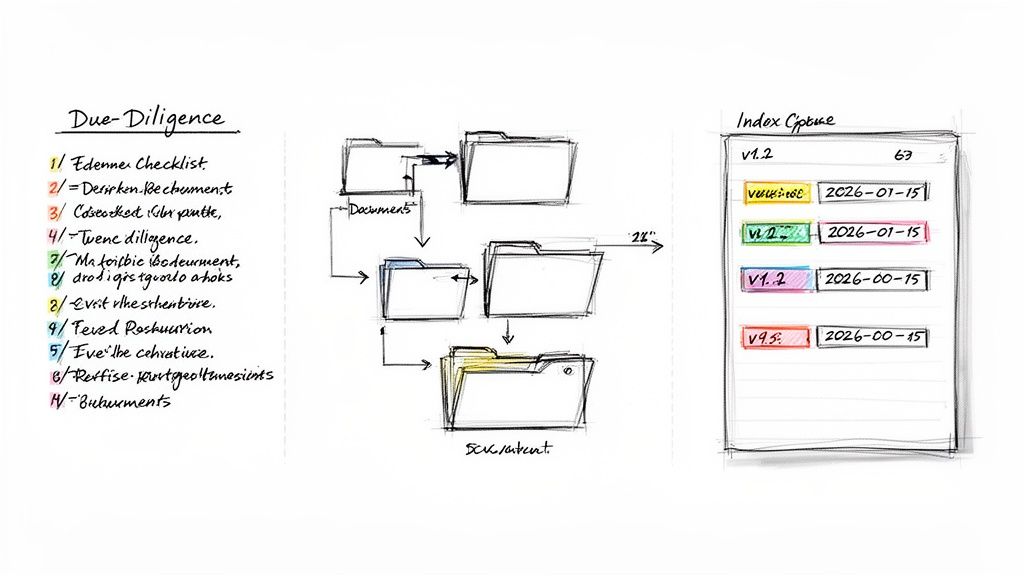
A logical folder structure is only the first step. The integrity of the evidence depends on disciplined data management for every file, which requires clear and consistently enforced rules for naming, indexing, and versioning. A predictable and descriptive naming convention is essential for preventing disorder.
A functional convention should include:
- Control ID: The specific framework identifier (e.g., A.12.1.2).
- Document Type: A short tag like
POL(Policy),PROC(Procedure), orEV(Evidence). - Description: A clear, human-readable name (e.g.,
Change-Management-Process). - Version: A simple version number (e.g.,
v1.2). - Date: The approval or review date in YYYY-MM-DD format.
A file named A.12.1.2_PROC_Change-Management-Process_v1.2_2024-10-28 is self-explanatory. This discipline removes ambiguity, making the VDR searchable and audit-friendly.
Creating Traceable Links Between Policy and Practice
The objective is to establish a clear and verifiable link between documented policies and operational evidence. A well-structured VDR demonstrates that governance is implemented in practice, not just on paper.
For example, an Information Security Policy may mandate quarterly vulnerability scans. To demonstrate compliance, the VDR folder for that policy should link to:
- The written procedure detailing how scans are conducted, the tools used, and responsible parties.
- Scan reports from the last four quarters, demonstrating consistent execution.
- Change management records showing that identified vulnerabilities were tracked and remediated.
This chain of linked evidence creates a complete and defensible narrative, making the relationship between policy, procedure, and proof explicit. More information on what constitutes strong audit evidence in our guide.
A well-organized VDR does more than present documents; it demonstrates operational resilience. Each file is a component of a larger narrative, showing how high-level policies are translated into tangible controls. This traceability is the hallmark of a mature governance program.
This level of organization provides significant internal value by offering a clear, real-time view of the control environment. It transforms the VDR from a temporary deal room into a persistent system for ongoing governance. Treating evidence organization as a core discipline builds a foundation of clarity capable of withstanding the intense scrutiny of any vdr due diligence process.
Managing Access and Monitoring Activity During Diligence
A Virtual Data Room is a live environment requiring continuous operational governance, not a static archive. During an active due diligence project, user permissions will require adjustment, new evidence will be added, and the scope of inquiry may shift. Maintaining oversight is a core function of managing this controlled, high-stakes environment. Here, the VDR's role as a governance system moves from initial setup to dynamic, real-time oversight.
Leveraging the Immutable Audit Trail
The foundation of governance during active diligence is the VDR's immutable, append-only audit trail. This feature provides a complete, unalterable record of every action taken within the system. It is the primary tool for verifying that controls are operating as designed and for identifying behavior that deviates from expected norms.
This log is a source of operational intelligence, providing verifiable answers to critical governance questions:
- Who accessed what? It tracks every document view, creating a clear record of which parties are engaging with specific evidence.
- When did they access it? Timestamps for all activities, from login to logout, help establish timelines and confirm engagement.
- What actions were taken? It records every download, print attempt (even if blocked), or Q&A submission, creating a full accountability record.
Reviewing these logs allows for confirmation that access patterns align with assigned roles. For example, if a user from a financial team repeatedly attempts to access technical schematics from which they are restricted, that is an event that requires immediate investigation.
Conducting Periodic Access Reviews
The principle of least privilege is not a static control. Roles evolve during a due diligence project. A team member who initially required broad access may shift to a more limited role, or a new specialist may join with very specific information needs. Security requires that permissions are reviewed and adjusted accordingly.
A structured, periodic access review is the mechanism for this process. It involves systematically examining every user account and its assigned permissions to ensure they remain appropriate for the current stage of the project. For instance, at the conclusion of a specific diligence phase, such as the initial legal review, it is prudent to reassess the permissions granted to the external legal team. If their work in that area is complete, their access should be restricted or revoked. This practice minimizes the window of exposure and adheres strictly to the principle of least privilege.
The VDR audit log should be treated as a primary source of system verification. It provides objective, machine-generated evidence of user behavior, allowing you to validate that your access controls are not just designed correctly but are also operating effectively in a live environment.
Identifying and Responding to Anomalous Behaviour
In addition to scheduled reviews, continuous monitoring of the audit trail is essential for identifying anomalies that could indicate a security risk. This involves recognizing patterns that fall outside of expected norms.
Consider a scenario where a user account suddenly authenticates from a different country at an unusual hour. While potentially legitimate, it requires immediate verification. Another anomaly might be a single user attempting to download an unusually high volume of documents in a short period, which could indicate an attempt at data exfiltration.
The response to a detected anomaly must be systematic. The first step is to temporarily suspend the account to contain any potential risk. Next, investigate the activity using the audit log's detailed records. Finally, based on the findings, a decision can be made to reinstate access, adjust permissions, or permanently revoke the account. This approach treats the VDR as a controlled environment where every action is observable and every deviation is accountable. Effective vdr due diligence relies on this continuous vigilance.
Using AI as a System Component, Not a Decision-Maker
Many modern Virtual Data Rooms incorporate AI-based features. It is important to view these not as autonomous solutions, but as system components. For CISOs and compliance teams, AI is a tool that operates within a governance framework, not an independent actor.
The objective is to augment human judgment, not replace it. AI can automate repetitive, high-volume tasks, making the vdr due diligence process more efficient and accurate. However, this is only true when it operates within a structure of human oversight and accountability. AI should be treated as a specialized component that performs specific, well-defined tasks, while ultimate accountability for all outcomes remains with human operators.
Practical AI Use Cases (Under Human Control)
Several AI-driven functions can accelerate analysis, but each requires a clear process for human verification. These tools amplify a team's capability; they do not remove their responsibility.
Practical applications include:
- AI-Powered Document Indexing: An AI can scan documents and suggest classifications that map to a due diligence checklist. A human reviewer, however, must always validate these classifications to ensure they accurately reflect the evidence in its proper context.
- Automated PII Redaction: These tools can significantly reduce manual effort by scanning files to identify potential Personally Identifiable Information (PII) for redaction. A compliance professional must still review every suggestion to confirm its accuracy and ensure no sensitive data was missed or non-sensitive data was incorrectly obscured.
- Sentiment Analysis: When analyzing large volumes of communications, an AI can identify patterns of negative or positive sentiment. This can help flag areas that warrant deeper investigation by legal or HR teams.
In each use case, the pattern is consistent: the AI performs the high-volume initial analysis, while the final, critical judgment remains a human responsibility. The system functions as a filter, directing expert attention where it is most needed.
An AI tool can identify a thousand potential instances of PII in an afternoon. But the compliance officer who approves the final redaction is the one who is ultimately accountable. The tool provides leverage, not absolution.
How to Govern AI as a System Component
Responsible use of AI in due diligence requires a robust governance framework focused on understanding system limits and maintaining a complete audit trail. It is essential to know how the models function and ensure their output is always verifiable.
A significant consideration is the potential for bias inherent in AI models, which may have limitations based on their training data. The governance team is responsible for understanding these potential biases and implementing mitigating controls. For example, if a redaction tool consistently fails to identify a specific ID number format, a manual spot-checking process must be designed to catch that error.
Finally, every action taken by an AI system must be recorded in the VDR's immutable audit trail. If an AI system automatically redacts a clause, the log must clearly indicate that the action was system-generated. Crucially, it must also identify which human user later reviewed and approved that action. This creates an unbroken chain of accountability, demonstrating that while automation was used, human oversight was never relinquished—a critical detail for building a defensible due diligence record.
Generating Defensible Audit-Ready Evidence Packs
The primary deliverable of a successful VDR due diligence process is the complete, defensible record of that process. This final evidence pack serves as a time-stamped, verifiable narrative of the entire exercise, demonstrating that it was managed with the rigor, transparency, and accountability required in regulated industries.
At the conclusion of diligence, the VDR should not simply be deactivated. A defined export procedure is necessary to generate a self-contained audit pack. This is a static snapshot of the VDR at the project's close, providing irrefutable proof of what was shared, who accessed it, and when. This final export serves as a defense against future regulatory scrutiny or legal disputes, as it allows third-party auditors or legal counsel to review the record without requiring access to the original live system.
Anatomy of a Defensible Evidence Pack
An audit-ready pack is more than a collection of documents; it is a structured, self-explanatory system that conveys the complete history of the diligence process. A properly generated pack must contain three core components.
- All Organized Evidence: Every document, spreadsheet, and presentation shared, exported with the exact folder structure and naming conventions used in the VDR to preserve the logical context.
- A Complete Document Index: A master index, typically as a CSV or PDF, that lists every file in the pack with metadata such as file name, version number, and its location within the folder structure.
- The Full, Immutable Audit Logs: The complete, unabridged audit trail from the VDR, including every login, document view, download, and Q&A submission, with precise timestamps and user details.
Together, these elements form a coherent body of evidence. An auditor can use the index to locate a document, review the evidence, and cross-reference the audit log to verify exactly who accessed that file and when.
Practical Tips for Structuring the Export
The method of data export is important. A large, disorganized data dump is of little use to an auditor. The goal is a package that is intuitive for an individual with no prior knowledge of the project.
A best practice is to export the entire evidence pack as a single compressed ZIP file. Within the archive, the evidence should mirror its original folder structure. The document index and complete audit logs should be saved as clearly labeled PDFs at the root level. This structure provides an auditor with a logical, self-contained record.
If you are preparing for an audit, you may find our guide on selecting the right document management system software useful.
The final evidence pack is the ultimate proof of a well-executed VDR due diligence process. Its value lies not just in the documents it contains, but in its ability to demonstrate systematic control, traceability, and accountability from start to finish.
This methodical approach transforms the VDR from a temporary transaction tool into a permanent system of record. It provides the concrete, verifiable evidence that an organization managed a sensitive process with the discipline demanded by auditors, regulators, and stakeholders.
At AuditReady, we provide an operational evidence toolkit designed for the complexities of regulated environments. Our platform helps you organize evidence, manage controls, and generate defensible, audit-ready packs with the clarity and traceability required for frameworks like DORA and NIS2. Learn more and prepare for your next audit with confidence at https://audit-ready.eu/?lang=en.